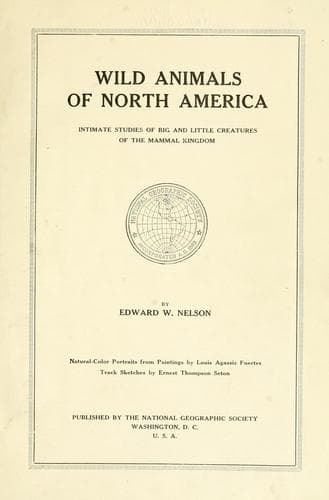
Wild Animals of North America: Intimate Studies of Big and Little Creatures of the Mammal KingdomNelson, Edward William
Science
Wild Animals of North America: Intimate Studies of Big and Little Creatures of the Mammal Kingdom
Nelson, Edward William
Mammals -- North America
These lemmings do not hibernate, but, active throughout the severest
winters, are abroad almost equally by day and by night. Their burrows
consist of winding tunnels, often many-branched and with more than one
opening. A dry bed of peat or a dense growth of moss is often pierced
by a network of them. Well-defined runways often lead away from the
burrows or from the entrance of one burrow to that of another.
Their tunnels run everywhere under the snow, with occasional passages
leading to the surface. When fierce gales blow away the snow or a
winter rain melts it, many lemmings lose touch with their burrows and
wander about until they perish from cold or are caught by some enemy.
They are sometimes found several miles from shore, where they have
strayed out on the sea ice.
In winter in the fur countries, in company with field mice, they invade
storehouses and habitations in search of food. Among their enemies are
ravens and all northern hawks and owls, as well as foxes, weasels,
lynxes, bears, and other beasts of prey of all degree.
Within their underground tunnels and often in dense vegetation on the
surface lemmings make warmly lined nests of grass and moss in which
their young, from two to eight in number, are born. The young appear at
varying times, thus indicating several litters each year.
When taken alive, the old ones are fierce and courageous, growling and
fighting savagely; but several half-grown young brought me during my
residence in Alaska proved to be most amusing and inoffensive little
creatures. From the first they permitted me to handle them without
offering to bite and showed no signs of fear.
They were kept in a deep tin box, from which they made continual
efforts to escape. When I extended one finger near the bottom of the
box they would stand erect on their hind feet and reach up toward
it, using their forepaws like little hands. If my finger was lowered
sufficiently they would climb up into my hand and thence to my
shoulder, showing no sign of haste, but much curiosity, continually
sniffing with their noses and peering at everything with their bright
beadlike eyes.
They were curiously expert in walking on their hind feet, holding the
body in an upright position and taking short steps. If anything was
held just out of reach above their heads, as the point of my finger,
they would continue in an erect position for a considerable time. At
such times they would reach up with their front paws and often spring
up on their hind feet for half an inch above the floor trying to
touch it. When eating they sat upright on their haunches, like little
marmots, and held the food in their front paws.
=THE COMMON FIELD MOUSE, OR MEADOW MOUSE= (=Microtus
pennsylvanicus= and its relatives)
(_For illustration, see page 522_)
Public-domain text, read in full here on John Shaqi.
Reviews
Reviews
No reviews yet
Be the first to share your thoughts on this work.
Elsewhere in the archive
Join the Discussion
Join the discussion
Sign in to leave a comment or review.
Sign InorCreate an account