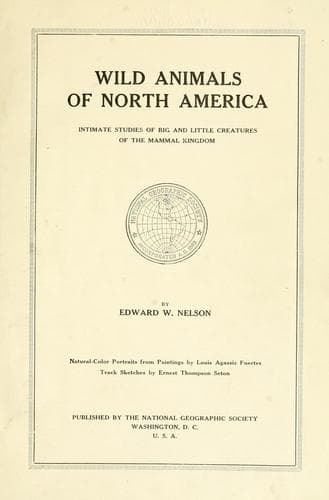
Wild Animals of North America: Intimate Studies of Big and Little Creatures of the Mammal KingdomNelson, Edward William
Science
Wild Animals of North America: Intimate Studies of Big and Little Creatures of the Mammal Kingdom
Nelson, Edward William
Mammals -- North America
The Pennsylvania meadow mouse is a small species about as long in body
as the house mouse, but much more heavily proportioned. Its head is
rounded, the eyes small and beadlike, the legs and tail are short, and
the comparatively coarse fur is so long that it almost conceals the
short, rounded ears.
It is a typical representative of a group of small mammals commonly
known as field mice, or “bear mice,” which includes a great number of
species closely similar in general appearance, but varying much in
size. In England they are termed voles, and large species living about
the water in England and northern Europe are known as “water rats.”
Field mice are circumpolar in distribution and abound from the
Arctic barrens, beyond the limit of trees, to southern Europe and the
Himalayas, in the Old World, and to the southern United States and
along high mountains through Mexico and Guatemala, in Central America.
They occur in most parts of the United States except in some of the
hotter and more arid sections.
As a rule field mice prefer low-lying fertile land, as grassy meadows,
but the banks of streams, the rank growths of swamps and marshes, the
borders of damp woodlands, the grassy places on Arctic tundras, or the
dwarfed vegetation of glacial slopes and valleys above timber-line on
high mountains furnish homes for one species or another.
Two, and even three, species of field mice are sometimes found in the
same locality, but each kind usually occupies a situation differing in
some way from that chosen by the others. Some occupy comparatively dry
ground and others, like the European water rat, live in marshes and are
almost as aquatic as the muskrat. Most species living about the water
are expert in diving and in swimming, even under water. In streams
inhabited by large trout they are often caught and eaten by the fish.
The presence of field mice is nearly always indicated by smoothly worn
little roads or runways about an inch in width, which form a network
among the vegetation in their haunts. These runways lead away from the
entrances of their burrows and wind through the vegetation to their
feeding grounds. They are kept clean and free from straws and other
small obstructions, so that the owners when alarmed may run swiftly to
the shelter of their burrows. Fully conscious of their helplessness,
meadow mice are as cautious as the necessities of existence will permit.
Their burrows are often in the midst of grassy meadows, as well as
under the shelter of logs, rocks, tussocks of grass, or roots of trees,
and lead to underground chambers filled with large nests of dry grass,
which shelter the owner in winter and often in summer. The summer nests
in many places, especially in damp meadows or marshes, are made in
little hollows in the surface or in tussocks of grass. In these nests
several litters containing from four to eleven young are born each year.
Public-domain text, read in full here on John Shaqi.
Reviews
Reviews
No reviews yet
Be the first to share your thoughts on this work.
Elsewhere in the archive
Join the Discussion
Join the discussion
Sign in to leave a comment or review.
Sign InorCreate an account