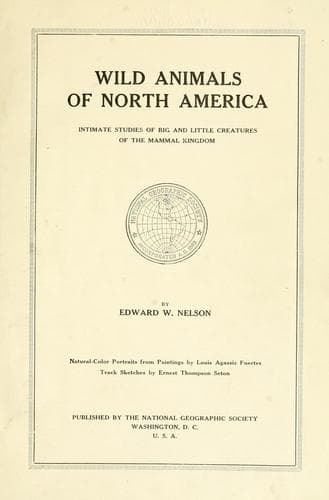
Wild Animals of North America: Intimate Studies of Big and Little Creatures of the Mammal KingdomNelson, Edward William
Science
Wild Animals of North America: Intimate Studies of Big and Little Creatures of the Mammal Kingdom
Nelson, Edward William
Mammals -- North America
Most of the pine mice are limited to the wooded region of the States
between the Atlantic coast and the eastern border of the Great Plains,
and from the Hudson River valley and the border of the Great Lakes
south to the Gulf coast. Strangely enough, one species lives in a
restricted belt covered with tropical forest along the middle eastern
slope of the Cordillera, which forms the eastern wall of the Mexican
tableland, on the border between the States of Vera Cruz and Puebla.
Pine mice occupy the borders of thin forests and brushy areas, from
which they work out into the open borderlands, especially in orchards
or other places where there are scattered trees amid a rank growth of
weeds. Instead of making their runways among growing vegetation on the
surface of the ground like field mice, they live in little underground
tunnels or burrows which extend in all directions through their haunts.
These tunnels are closely like those of the common mole except that
they are smaller and have frequent openings to the surface, through
which the owners make short excursions for food. They often utilize the
tunnels of moles when conveniently located for their purposes.
The tunnels are often so near the surface that the ground is slightly
uplifted or broken as by a mole, or they are made under the fallen
leaves and other small decaying vegetable matter covering the ground
under the trees. Occasionally, when the surface soil becomes dry and
hard, the burrows are deeper, so that no surface indications can
be discovered. On account of the similarity of their burrows the
depredations of pine mice are commonly attributed to moles.
Several inches below the surface pine mice excavate oval chambers to
be used for nests or for storage purposes. The nest chambers have
several entrances from ramifying tunnels and are filled with short fine
pieces of grass, making a warm nest-ball. Here the several litters of
young are born each year. Pine mice are less prolific than field mice,
however, and the litters contain only from one to four young.
The food chambers are larger than the nest chambers, and when full of
stores are kept closed with earth. In these are stored short sections
of green or dry grasses, bulbous grass roots, and short sections of
other edible roots. One such store contained about three quarts of the
fleshy roots of a morning glory cut into short sections.
Pine mice obtain much of their food from the bark about the bases and
roots of trees, including both coniferous and deciduous species. They
kill many small trees and shrubs by girdling, or by cutting the roots
below the surface, and in this way frequently inflict severe damage in
orchards and nurseries. Owing to their underground habits they are much
more dangerous to orchards than field mice. They also do much damage by
burrowing along rows of potatoes and other root crops, upon which they
feed.
Public-domain text, read in full here on John Shaqi.
Reviews
Reviews
No reviews yet
Be the first to share your thoughts on this work.
Elsewhere in the archive
Join the Discussion
Join the discussion
Sign in to leave a comment or review.
Sign InorCreate an account