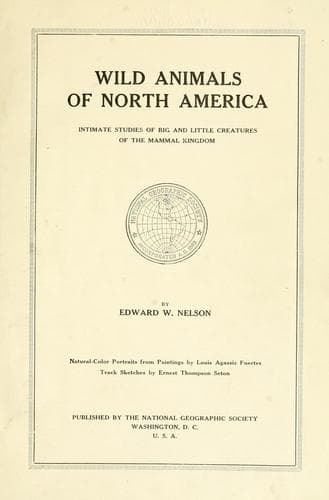
Wild Animals of North America: Intimate Studies of Big and Little Creatures of the Mammal KingdomNelson, Edward William
Science
Wild Animals of North America: Intimate Studies of Big and Little Creatures of the Mammal Kingdom
Nelson, Edward William
Mammals -- North America
Both pine mice and field mice are serious pests to agriculture and
only by vigilant care can they be prevented from steadily reducing
the returns from farm and orchard. A mouse appears so insignificant
an enemy that the general inclination among farmers is to ignore it,
but both field and pine mice exist in such enormous numbers and are so
generally distributed that the aggregate annual losses from them are
great.
Clean cultivation in orchards, especially for some distance immediately
about the trees, is an excellent protective measure against both of
these mice. The shrubbery and fruit trees of orchards, lawns, and
gardens may be protected by the use of poisoned baits and traps as soon
as signs of pine mice or field mice are observed.
=THE RED-BACKED MOUSE= (=Evotomys gapperi= and its relatives)
(_For illustration, see page 523_)
With the exception of the banded lemmings the red-backed mice are the
most brightly colored of the smaller northern rodents. They are close
relatives of the common field mice, which they about equal in size,
but from which they are distinguished externally by rufous coloration,
finer and more glossy pelage, larger ears, and proportionately longer
tails.
The red-backed mice form a group containing a considerable number
of species distributed throughout the northern circumpolar lands,
except on the barren islands of the Arctic Sea. In North America they
occur from the Arctic tundras north of the limit of trees southward
throughout Alaska and Canada to the northern United States. With other
northern species of mammals, birds, and plants they follow the high
mountain ranges still farther southward to North Carolina, New Mexico,
and middle California.
It is true that in the far North they are numerous on the moss-grown
tundras, and in the South range above timber-line on high mountains.
As a general rule, however, they are woodland animals, whether among
the spruces, birches, and aspens of the North or farther south in the
United States in the cool fir and aspen-clad slopes of mountains. They
also frequent old, half-cleared fields, brush-grown or rocky areas, and
similar places where cover is abundant.
Although so closely related to the field mice, the red-backed species
are not known to become excessively abundant nor seriously to injure
crops. One reason for their harmlessness in this respect may be their
strong preference for forest haunts.
I once found them numerous in the grass-grown streets and yards of an
abandoned mining camp in the forest at the head of Owens River, in the
Sierra Nevada, of California. The mice were making free use of the
congenial shelter afforded by the old log cabins, and their runways and
entrances to burrows were all about under scattered boards and similar
cover.
Public-domain text, read in full here on John Shaqi.
Reviews
Reviews
No reviews yet
Be the first to share your thoughts on this work.
Elsewhere in the archive
Join the Discussion
Join the discussion
Sign in to leave a comment or review.
Sign InorCreate an account