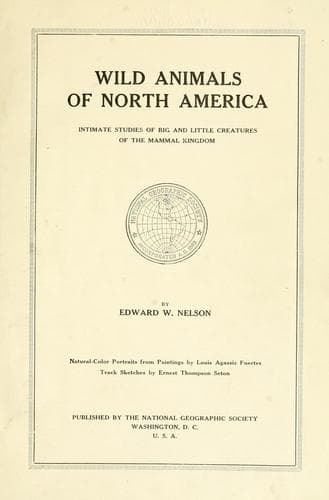
Wild Animals of North America: Intimate Studies of Big and Little Creatures of the Mammal KingdomNelson, Edward William
Science
Wild Animals of North America: Intimate Studies of Big and Little Creatures of the Mammal Kingdom
Nelson, Edward William
Mammals -- North America
So far as known, the living members of the genus are confined to the
Boreal parts of North America, where they range from the Atlantic
to the Pacific in Canada, and southward along the mountains to New
Hampshire, New Mexico, and northern California. The discovery of fossil
representatives of the genus in Hungary and England indicates that it
was formerly circumpolar in distribution.
All but one species of the genus live on the ground, inhabit burrows,
make runways through the small vegetation, and feed on grasses and
other herbage--all in close conformity with the habits of the meadow
mice.
The tree mouse, however, is a strongly aberrant member of the group. It
differs from all the others, and from all field mice, not only in its
rufous color and longer tail, but in its remarkable mode of life. It is
restricted to the humid region of magnificent forests in western Oregon
and northwestern California, where it often spends its life in the tops
of such noble trees as the Sitka spruce, the Douglas fir, and the coast
redwood. Such an amazing departure from the habits of its kind lends
unusual interest to this little animal.
Its nests are generally located high up in the trees, sometimes 100
feet from the ground, in forests where the branches of neighboring
trees interlace so that it can pass from one to another and inhabit
a world of its own, free from the ordinary four-footed enemies which
prowl below.
The nests vary in size, structure, and location. In Oregon they have
been found only in large trees at elevations varying from 30 to 100
feet. On the seashore near Eureka, California, they are placed on the
branches of small second-growth myrtle and redwood trees. Farther
inland in the same region many are in small trees, within a few yards
of the ground, on the border of heavy redwood forests.
The higher nests of the tree mice are often the deserted and remodeled
homes of the big gray tree squirrel of that region (_Sciurus griseus_)
and contain a foundation of coarser sticks than in the nests wholly
built by the mice. The larger proportion of the nests are built by the
mice and are usually composed of small twigs, fragments of a netlike
lichen, skeletons of fir, spruce, or other coniferous leaves, and the
droppings of the mice themselves. They vary from small oval structures
a few inches in diameter, located well out on the branches, to great
masses close against and sometimes entirely surrounding the tree
trunks, supported on several branches, and measuring three feet long
and two or three feet high.
The interior of these large structures is pierced with numerous
passageways and sometimes as many as five separate nest chambers are
scattered through one. Tunnels run out along each of the limbs on which
the mass rests, and if it extends all the way round one main tunnel
encircles the trunk from which these hallways branch.
Public-domain text, read in full here on John Shaqi.
Reviews
Reviews
No reviews yet
Be the first to share your thoughts on this work.
Elsewhere in the archive
Join the Discussion
Join the discussion
Sign in to leave a comment or review.
Sign InorCreate an account