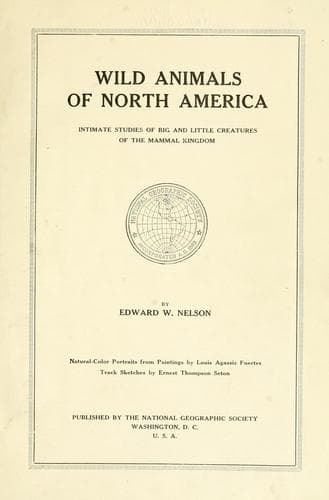
Wild Animals of North America: Intimate Studies of Big and Little Creatures of the Mammal KingdomNelson, Edward William
Science
Wild Animals of North America: Intimate Studies of Big and Little Creatures of the Mammal Kingdom
Nelson, Edward William
Mammals -- North America
Such great nests have evidently been used for a long period and have
grown with the steady accumulation of material. This has gradually
decayed and become a solid mass of earthy humus. The large nests are
usually the abodes of a single female, the homes of the males having
been found to be small and more often located away from the trunk of
the tree. The food of the red tree mouse, so far as known, consists
entirely of the fleshy parts of fir and spruce needles and the bark
from coniferous twigs.
Tree mice appear to breed throughout most of the year and have from
one to four young in a litter. They are mainly nocturnal, and when
driven from their nests by day appear rather slow and uncertain in
their movements. Those living in highly placed nests usually escape
by running out on the limbs, and pass from one tree to another if
necessary. Those in small trees usually drop quickly from limb to limb
until they reach the ground, when they run to the nearest shelter.
That these mice sometimes descend to the ground of their own volition
is probable, but the fact that the stomach of every individual so far
examined has contained only the fleshy parts of coniferous leaves
indicate that their food habits have become so fixed as to make
arboreal life a necessity.
The modification of the habits of a member of a group of
ground-frequenting animals, with a structure adapted to such an
existence, to those of a strictly arboreal animal is so strange as to
make the question of cause a puzzling one.
In the Hawaiian Islands the introduction of the mongoose has made the
common house rat arboreal in habits, and possibly in the remote past
the pressure of some ground-frequenting enemy thus affected the lives
of the red tree mouse. An animal rarely makes an abrupt change in its
habits without direct pressure from some source, and then only as a
matter of self-preservation.
=THE MUSKRAT= (=Fiber zibethicus= and its relatives)
(_For illustration, see page 526_)
The muskrat, or “musquash,” as it is widely known in the northern fur
country, is three or four times the size of the common house rat, to
which it bears a superficial resemblance. It has a compactly formed
body, short legs, and strong hind feet partly webbed and otherwise
modified for swimming. The long, nearly naked, and scaly tail is
strongly flattened vertically and in the water serves well as a rudder.
The fur is nearly as fine and dense as that of the beaver and, as in
that animal, protects its owner from the cold water in which so much of
its life is spent.
Public-domain text, read in full here on John Shaqi.
Reviews
Reviews
No reviews yet
Be the first to share your thoughts on this work.
Elsewhere in the archive
Join the Discussion
Join the discussion
Sign in to leave a comment or review.
Sign InorCreate an account