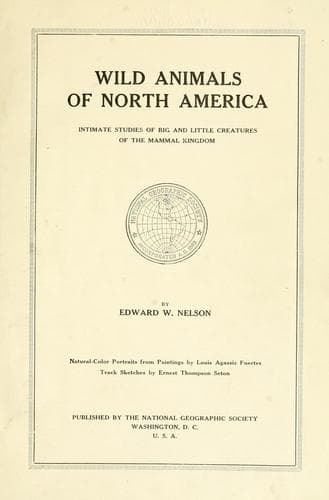
Wild Animals of North America: Intimate Studies of Big and Little Creatures of the Mammal KingdomNelson, Edward William
Science
Wild Animals of North America: Intimate Studies of Big and Little Creatures of the Mammal Kingdom
Nelson, Edward William
Mammals -- North America
On warm sunny days, especially at a time when nights are frosty,
these fat little animals will often lie flat on the bare ground about
their mounds, with legs outstretched, basking in the grateful rays.
As their colonies expand by the rapid increase of their numbers, many
individuals wander far in search of new locations. On the mountain
plateaus of northern Arizona I know of instances where they have
traversed several miles of pine and fir forest to locate in an isolated
mountain park, and new colonies were established as far as six miles
from their nearest neighbors.
The flesh of prairie-dogs is not unpalatable, and Navajo and Pueblo
Indians are extremely fond of it. The Indians take advantage of heavy
rains and turn the temporary rush of water down the holes to drown out
the “dogs,” and thus capture many of them.
It is inevitable that many popular misconceptions should grow up about
such numerous and interesting animals as the prairie-dogs. In the West
many people believe that the burrows go down to water. In reality,
like many other rodents, these animals have acquired the ability by
chemical action in the stomach to transform the starchy food into
water. I have seen dog towns located on a few feet of soil resting on
a waterless lava bed miles in extent and more than 100 feet thick, as
shown by canyons cut through it, thus proving the impossibility of the
prairie-dog-well legend.
Another popular belief is that the rattlesnakes and burrowing owls
living in prairie-dog towns unite as a kind of happy family in the
burrows of the dogs. The truth is that the owls live and breed in
deserted dog holes, while the rattlesnakes visit the occupied holes to
feed on the unfortunate occupants.
=THE STRIPED GROUND SQUIRREL= (=Citellus tridecemlineatus=
and its subspecies)
(_For illustration, see page 538_)
Small size and a series of thirteen narrow, well-defined stripes, or
lines, marking the upperparts of the striped ground squirrel serve to
distinguish it from all its relatives. Its total length is about eleven
inches and its form is nearly as slender as that of the weasel. Its
brightly colored markings blend so well with the brown earth and plant
stems in its haunts that when quiet it is difficult to distinguish.
This protective coloration is of vital service to a small animal
sought by all the diurnal birds of prey, as well as by coyotes, foxes,
bobcats, badgers, skunks, weasels, and snakes.
The striped ground squirrel, also known as the “gopher” or “striped
gopher,” is restricted to middle North America, where it is distributed
from southern Michigan and northern Indiana west to Utah, and from
about latitude 55 degrees in northern Alberta south nearly to the
Gulf coast of Texas. It ranges from near sea level in Texas up nearly
to 10,000 feet in Colorado. Within these limits the varying climatic
conditions have modified it into several geographic races, all having a
close general resemblance.
Public-domain text, read in full here on John Shaqi.
Reviews
Reviews
No reviews yet
Be the first to share your thoughts on this work.
Elsewhere in the archive
Join the Discussion
Join the discussion
Sign in to leave a comment or review.
Sign InorCreate an account