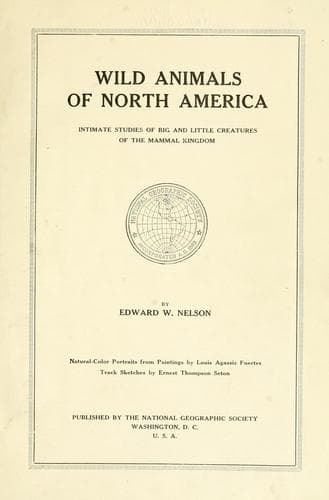
Wild Animals of North America: Intimate Studies of Big and Little Creatures of the Mammal KingdomNelson, Edward William
Science
Wild Animals of North America: Intimate Studies of Big and Little Creatures of the Mammal Kingdom
Nelson, Edward William
Mammals -- North America
I once stalked a solitary antelope by creeping flat on the ground
through a prairie-dog “town.” As I drew near the first burrows, the
“dogs” all rushed to their mounds, sitting there and barking at the
queer and unknown animal thus invading their precincts. The strange
sight excited as much curiosity among them as alarm. As I approached
one mound after another the owners would become almost hysterical in
their excitement and would sit first on all fours and then stand up
at full height on their hind feet, the tail all the time vibrating as
though worked by some mechanism, while the barking continued at the
intruder as rapidly and explosively as possible. When I came within
six or eight feet the “dog” would dive down his hole, sputtering barks
from the depths as he went, but often would pop up again to take
another look before finally disappearing. In this way I passed ten or a
dozen mounds while the dozens of “dogs” off my line of progress worked
themselves into a frenzy of curiosity and protest. When the stalk was
finished I passed back through the “town” and my upright figure was
promptly recognized by the habitants as that of an enemy and every one
disappeared before I was within fifty yards of the first mound.
The common note of the black-tailed prairie-dogs is a squeaking “bark,”
much like that produced by squeezing a toy dog; in addition, there is a
rapid chattering note, often given as the “dogs” vanish down the hole.
The white-tailed species have a shriller, more chirping note. In both
species the odd vibrating motion of the tail, held stiffly close to the
back, is characteristic.
Prairie-dogs hibernate in severe weather, those living in high,
snow-covered mountains or in the far north sometimes sleeping through
five or six months. In many places their hibernation is irregular, and
near the southern border of their range is limited to a few inclement
days now and then. In Wyoming they come out the last of March or early
in April, sometimes when there is a foot or two of snow on the ground
and the temperature ranges far below zero. Under such conditions they
run about over the snow during the middle of the day, feeding on
projecting tips of vegetation or digging to the ground.
Beginning near the southern border of their range and proceeding north,
the single litter of the season, containing from four to six young,
are born in March, April, or May, and a month later, when scarcely
larger than chipmunks, may be seen playing about the entrance mound.
When danger appears the mother sends the young helter-skelter for
the refuge of the burrow, and should any be slow about going in she
rushes at them, driving them to cover with shrill barks of alarm. When
about half-grown the young scatter and prepare burrows of their own.
Sometimes as many as six to nine of these animals may be found in a
single burrow, in which, no doubt, they have taken refuge, or it may be
a reunion of the season’s family.
Public-domain text, read in full here on John Shaqi.
Reviews
Reviews
No reviews yet
Be the first to share your thoughts on this work.
Elsewhere in the archive
Join the Discussion
Join the discussion
Sign in to leave a comment or review.
Sign InorCreate an account