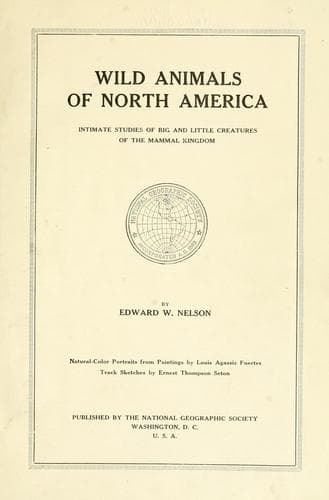
Wild Animals of North America: Intimate Studies of Big and Little Creatures of the Mammal KingdomNelson, Edward William
Science
Wild Animals of North America: Intimate Studies of Big and Little Creatures of the Mammal Kingdom
Nelson, Edward William
Mammals -- North America
Ground squirrels are agile climbers on cliffs and among rocks as well
as in fruit trees, live oaks, and other low trees, but I have never
seen them far from the ground in large trees. When on the ground they
run in a series of bounds like tree squirrels. The long, bushy tail is
carried almost straight out behind when they scamper off in alarm, but
at other times is curved and undulating, much as in the tree squirrels.
They gather and manipulate food with their front paws, sitting upright
on their haunches to eat or look about. On one occasion when I came to
a foot-bridge over a broad irrigating ditch across which a number of
ground squirrels were raiding an orchard, they did not hesitate to dash
at full speed into the swiftly running water and swam quickly across to
seek refuge in their holes on the far side.
Like other spermophiles, the California ground squirrels hibernate
for months in the cold, snow-covered parts of their winter range, but
remain active throughout the year in the warmer areas, where no snow
falls. Throughout their range they gather stores of seeds, grain,
and acorns and other nuts, carrying them in their cheek pouches to
underground store-rooms for use in bad weather. In the valleys of
California they lie hidden in their burrows for days at a time during
cold winter rains, but are out as soon as the sun reappears. One or
more litters, each containing from six to twelve young, are born from
March to late in summer, according to the locality. The young leave the
nest and care for themselves when about half grown.
The swarming abundance of the California ground squirrel on foothill
slopes and in fertile valley bottoms equals the congregations of
prairie-dogs in their most populous districts. This abundance of small
animal life supports a great variety of predatory species, as coyotes,
foxes, bobcats, several kinds of hawks, and the golden eagle. Owing to
its predilection for ground squirrels, the golden eagle is protected
by law in California, where many of them build their nests in low live
oaks only a few yards from the ground.
When house rats brought the bubonic plague to San Francisco a few years
ago they also carried it across the bay and passed it on to the ground
squirrels living in the foothills back of Oakland. Thence the disease
spread among these animals through parts of several surrounding
counties. The United States Public Health Service and the local
authorities in a vigorous campaign stopped the spread of this malady,
but not until the potential ability of these rodents as plague-carriers
had been well established. This fact and the wide distribution of
the California and other ground squirrels over a large part of the
continent should not be overlooked in connection with possible
future outbreaks of the plague. Fortunately, investigation and field
experiments on a large scale have shown that these spermophiles may be
destroyed by poison over great areas at a relatively small cost.
Public-domain text, read in full here on John Shaqi.
Reviews
Reviews
No reviews yet
Be the first to share your thoughts on this work.
Elsewhere in the archive
Join the Discussion
Join the discussion
Sign in to leave a comment or review.
Sign InorCreate an account