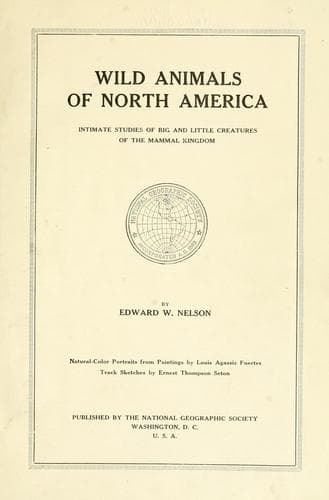
Wild Animals of North America: Intimate Studies of Big and Little Creatures of the Mammal KingdomNelson, Edward William
Science
Wild Animals of North America: Intimate Studies of Big and Little Creatures of the Mammal Kingdom
Nelson, Edward William
Mammals -- North America
=THE ANTELOPE CHIPMUNK= (=Ammospermophilus leucurus= and its
relatives)
(_For illustration, see page 539_)
Commonly known as the antelope, or white-tailed, chipmunk, this
handsome little mammal is in reality a species of spermophile, or
ground squirrel. The misnomer is due, no doubt, to its small size,
striped back, and sprightly ways. From the true chipmunks it may be
distinguished by its heavier proportions, and from both chipmunks and
all other spermophiles by its odd, upturned tail, carried closely
recurved along the top of the rump. This character renders the species
unmistakable at a glance and gives it an amusing air of jaunty
self-confidence.
The antelope chipmunk is characteristic of the arid plains and lower
mountain slopes of the Southwest from western Colorado through Utah,
northern Arizona, Nevada, the southern half of California, and all of
Lower California, and down the Rio Grande Valley through New Mexico to
western Texas.
Within this area it occupies a wide variety of situations. It inhabits
the intensely hot desert plains near sea level in Lower California,
where the temperature rises to more than 125 degrees Fahrenheit in the
shade and the vegetation is characterized by such picturesque forms
of plant life as cactuses of many species, yuccas, fouquerias, palo
verdes, ironwood, and creosote bushes; it is found also above 7,000
feet altitude on the cool plateaus and mountain slopes of Arizona and
Colorado, among sage brush, greasewood, junipers, and piñon pines. It
appears equally at home skipping nimbly over rocky slopes or among
slide rock in arid canyons and scurrying through the brushy growth on
broad sandy plains devoid of rocks.
The antelope chipmunk has the most vivacious and pleasing personality
of all the numerous ground squirrels within our borders. During the
many months I have camped and traveled on horseback in their haunts I
have never lost interest in them. They were forever skirmishing among
the bushes or dashing away down trails or over the rocks of canyon
slopes, their white tails curled impudently over their backs like flags
of derision at my cumbersome advance.
Their burrows are dug in a variety of places. In the open flats they
enter the ground almost vertically, and often several entrances are
grouped within a few yards. In some places a little mound of loose
dirt is heaped up at one side of the entrance and at others there is
no trace of it. Frequently, when the ground is soft, little trails
lead in different directions from the entrances, and often between
holes 100 yards or more apart, as though they made many social visits.
The deserted burrows of other mammals are sometimes utilized to save
the trouble of digging. The burrows are often under the shelter of
cactuses, bushes, and great boulders or may be among crevices in the
rocks.
Public-domain text, read in full here on John Shaqi.
Reviews
Reviews
No reviews yet
Be the first to share your thoughts on this work.
Elsewhere in the archive
Join the Discussion
Join the discussion
Sign in to leave a comment or review.
Sign InorCreate an account