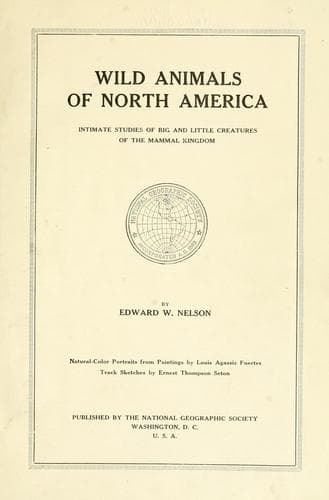
Wild Animals of North America: Intimate Studies of Big and Little Creatures of the Mammal KingdomNelson, Edward William
Science
Wild Animals of North America: Intimate Studies of Big and Little Creatures of the Mammal Kingdom
Nelson, Edward William
Mammals -- North America
They vary much in numbers from year to year and at times appear to
increase suddenly in localities where food is plentiful, indicating a
probable food migration. The young, numbering from four to six in a
litter, are born at varying times between the last of April and late
summer, indicating the possibility of more than one litter a season.
The most characteristic note of this chipmunk is a throaty _chuck,
chuck_, which is ordinarily used as a call note, but which in spring is
uttered many times in rapid succession to express the seasonal feeling
of joy and well being, thus taking on the character of a song. Such
joyful notes may be heard on every hand in places where the little
songsters are numerous. In addition, they have a high-pitched, chirping
note and a small churring whistle when much alarmed.
=THE OREGON CHIPMUNK= (=Eutamias townsendi= and its relatives)
(_For illustration, see page 543_)
The resident species of birds and mammals in the humid coastal region
of Oregon, Washington, and southern British Columbia are strikingly
characterized by their darker and browner colors in comparison with
closely related species in more arid districts.
The Oregon chipmunk is one of the common species showing marked
response to these local climatic conditions and is the darkest of all
the many species of chipmunks in the Western States. This chipmunk is
one of several geographic races into which the species is divided by
changing environment. The species, as a whole, ranges along the west
coast from British Columbia to Lower California, and the races at the
extremes of the line differ much in color.
As befits a habitant of the humid forested region, the Oregon chipmunk
is robustly built and distinctly larger than the other chipmunks of
the Western States. It is common and generally distributed throughout
this region, occurring from among the drift logs along the ocean beach
to above timberline on the Cascade Mountains. Within these limits
it frequents almost every variety of situation. It occurs in the
midst of gloomy forests of giant spruces, cedars, and firs, but is
particularly fond of old fences and brush patches on the borders of
farm clearings in the valleys as well as the vicinity of rocky ledges,
brush piles, and fallen timber, where the low thickets offer a variety
of food-bearing plants and ready shelter.
Public-domain text, read in full here on John Shaqi.
Reviews
Reviews
No reviews yet
Be the first to share your thoughts on this work.
Elsewhere in the archive
Join the Discussion
Join the discussion
Sign in to leave a comment or review.
Sign InorCreate an account