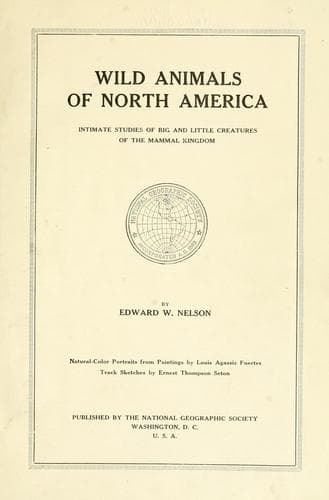
Wild Animals of North America: Intimate Studies of Big and Little Creatures of the Mammal KingdomNelson, Edward William
Science
Wild Animals of North America: Intimate Studies of Big and Little Creatures of the Mammal Kingdom
Nelson, Edward William
Mammals -- North America
At all seasons they fill their cheek pouches with food to be carried
away to their dens, but toward the end of summer or early fall they
work industriously laying up stores of seeds and nuts. Sometimes these
stores, hidden in chambers excavated for the purpose or in hollow logs
and similar places, contain several quarts of beechnuts or other nuts
or seeds. Small quantities of such food are hidden here and there under
the leaves or in shallow pits in the ground. Store-rooms in one burrow
contained a peck of chestnuts, cherry pits, and dogwood berries, and
another had a half bushel of hickory nuts.
[Illustration: ABERT SQUIRREL
_Sciurus aberti_
KAIBAB SQUIRREL
_Sciurus kaibabensis_]
While at a summer camp I once saw one of these chipmunks give an
exhibition of the exquisitely keen power of scent which must be
necessary to recover scattered stores. The chipmunk had been coming
repeatedly down a wooded slope in full view for twenty-five yards or
more to the floor of the porch for food supplied by the campers. While
it was absent carrying food to its burrow I placed a few nut meats on
the flat top of a stump about fifteen feet to one side of the porch
and farther away than the point where the chipmunk was being fed bread
crumbs. On its return several minutes later, instead of going as usual
to the porch, it ran directly to the stump, climbed up it, and promptly
made off with the nuts, which it had evidently located from afar. They
sometimes climb beeches and other trees to gather nuts even to a height
of fifty or sixty feet, and are commonly seen on low limbs and in
bushes.
[Illustration: FLYING SQUIRREL
_Glaucomys volans_]
[Illustration: BLACK-FOOTED FERRET
_Mustela nigripes_]
The entrances to the burrows are usually under logs, roots, or rocks,
or the den may be in a hollow log, stump or base of a tree, or even
under a cabin in the woods. The burrows in the ground are commonly a
series of tunnels some yards in length, with an oval nest and storage
chamber two or three feet underground, and with branches from the main
passageway. The nest chamber, a foot or more in diameter, is filled
with fragments of dry leaves and other soft vegetable material. One
chamber is usually used for sanitary purposes. The used entrance hole
is commonly without a sign of dug earth about it, the loose soil from
the burrow and its chambers apparently having been thrown out at
another opening, which appears to be used for this purpose only and is
kept plugged with earth.
Throughout most of the northern half of its range these chipmunks
usually hibernate from some time in October until March. Their
hibernation is far less profound than that of the woodchuck and they
not infrequently appear above ground during periods of mild weather,
even in midwinter. The hibernating period is shorter in the southern
part of the range.
Public-domain text, read in full here on John Shaqi.
Reviews
Reviews
No reviews yet
Be the first to share your thoughts on this work.
Elsewhere in the archive
Join the Discussion
Join the discussion
Sign in to leave a comment or review.
Sign InorCreate an account