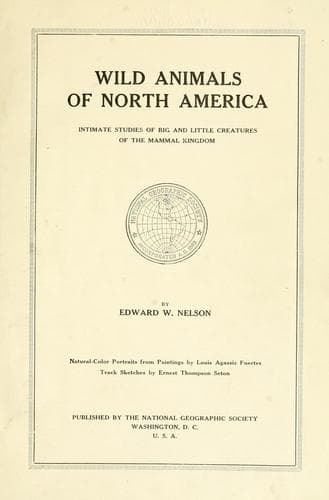
Wild Animals of North America: Intimate Studies of Big and Little Creatures of the Mammal KingdomNelson, Edward William
Science
Wild Animals of North America: Intimate Studies of Big and Little Creatures of the Mammal Kingdom
Nelson, Edward William
Mammals -- North America
On stormy and cloudy days, especially if the weather is cool, painted
chipmunks remain in their dens, but on mild sunny days they frisk about
with amazingly quick darting movements. A horseman riding along a road
leading through a sagebrush flat will frequently see them racing across
the road often several hundred yards away, the sound of the horse’s
footfalls having alarmed the chipmunks over a wide area. Here and there
one may be seen climbing hastily to the top of a tall bush to take a
look at the cause of alarm before finally seeking concealment. When
pursued among the bushes they often run considerable distances before
taking refuge in a burrow. When hard pressed they will enter the first
opening encountered, but if it is not its own home the fugitive soon
comes out and scampers away, apparently fearful of the return of the
owner or perhaps owing to his presence.
[Illustration:
Winter Summer
LEAST WEASEL
_Mustela rixosa_]
[Illustration: LARGE WEASEL, or STOAT (Winter and Summer)
_Mustela arcticus_] Apparently, as in the case of many other desert
mammals, the painted chipmunk, with its related races, is able to
subsist without drinking, since it is often seen far out on arid
plains many miles from the nearest water.
[Illustration: MARTEN, or AMERICAN SABLE
_Martes americana_]
[Illustration: AMERICAN MINK
_Mustela vison_]
As with all its kind, the world of the painted chipmunk is filled with
imminent peril of sudden death. Overhead, gliding on silent pinions,
are hawks of several species, while on the ground snakes, weasels,
badgers, bobcats, foxes, and coyotes are ever searching for them as
prey.
=THE RED SQUIRREL= (=Sciurus hudsonicus= and its relatives)
(_For illustration, see page 546_)
Every one who has visited the forests of Canada and northeastern
United States knows the vivacious, rollicking, and frequently impudent
red squirrel. This entertaining little beast, known also as the
pine squirrel and chickaree, has little of that woodland shyness so
characteristic of most forest animals. It often searches out the human
visitor to its haunts and from a low branch or tree trunk sputters,
barks, and scolds the intruder, working itself into a frenzy of
excitement. This habit, combined with the rusty red color and small
size of the animal, about half that of the gray squirrel, renders its
identity unmistakable. It has distinct winter and summer coats, but
in both the rusty red prevails. The winter dress is distinguished,
however, by small tufts on the ears.
Public-domain text, read in full here on John Shaqi.
Reviews
Reviews
No reviews yet
Be the first to share your thoughts on this work.
Elsewhere in the archive
Join the Discussion
Join the discussion
Sign in to leave a comment or review.
Sign InorCreate an account