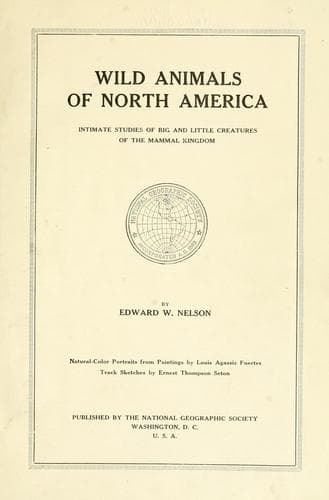
Wild Animals of North America: Intimate Studies of Big and Little Creatures of the Mammal KingdomNelson, Edward William
Science
Wild Animals of North America: Intimate Studies of Big and Little Creatures of the Mammal Kingdom
Nelson, Edward William
Mammals -- North America
The red squirrel, with its related small species, occupying most of
the wooded parts of North America north of Mexico, forms a strongly
characterized group, with no near kin among the squirrels of the Old
World. In its geographic races it ranges through the forests of all
Alaska and Canada and south to Idaho, Wyoming, the Dakotas, Wisconsin,
northern Indiana, all the Northeastern States to the District of
Columbia, and along the Alleghenies to South Carolina. Owing to its
small size, this animal, like the chipmunk, is considered too small
for game, although occasionally hunted for sport. As a consequence its
increase or decrease is usually governed by the available food supply,
although man interferes locally when it becomes too destructive.
This squirrel shows a strong preference for coniferous forests, whether
of hemlock, spruce, fir, or pine, but may be common in woods where
conifers are few and widely scattered. Although usually diurnal and
busily occupied from sunrise until sunset, it sometimes continues its
activities during moonlight nights, especially when nuts are ripe and
it is time to gather winter stores. During warm, pleasant days in
spring and fall, when the nights are cool, it often lies at full length
along the tops of large branches during the middle of the day, basking
in the grateful warmth of the sun.
The nests, which are located in a variety of situations, are made of
twigs, leaves, or moss, and lined with fibrous bark and other soft
material. Some are in knot-holes or other hollows in trees, others
may be built outside on limbs near the trunk, and still others are
in burrows made in the ground under roots, stumps, logs, brush heaps,
or other cover offering secure refuge. Apparently several litters, of
young, containing from four to six, are born each season, as they have
been found from April to September.
They do not hibernate, but are active throughout the year, except
during some of the coldest and most inclement weather. To provide
against the season of scarcity, they accumulate at the base of a tree,
under the shelter of a log, or other cover, great stores of pine,
spruce, or other cones, sometimes in heaps containing from six to
ten bushels. They also hide scattered cones here and there and place
stores of beechnuts, corn, and other seeds in hollows or underground
store-rooms. They are fond of edible mushrooms and sometimes lay up
half a bushel of them among the branches of trees or bushes to dry for
winter use. In the western mountains their great stores of pine cones
are often robbed by seed-gatherers for forestry nurseries. In winter
they tunnel through the snow to their hidden stores and sometimes
continue the tunnels from one store to another.
Public-domain text, read in full here on John Shaqi.
Reviews
Reviews
No reviews yet
Be the first to share your thoughts on this work.
Elsewhere in the archive
Join the Discussion
Join the discussion
Sign in to leave a comment or review.
Sign InorCreate an account