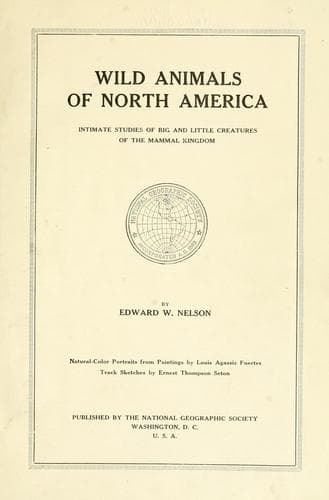
Wild Animals of North America: Intimate Studies of Big and Little Creatures of the Mammal KingdomNelson, Edward William
Science
Wild Animals of North America: Intimate Studies of Big and Little Creatures of the Mammal Kingdom
Nelson, Edward William
Mammals -- North America
In many places the soft, moist earth in the woods is riddled with
little pits dug by these squirrels apparently when they are after larvæ
or perhaps edible roots. Throughout the summer, but especially during
the last half of the season, and in autumn Douglas squirrels work with
persistent energy to amass great stores of seed-bearing cones, which
they heap, sometimes bushels of them, about the bases of trees, stumps,
and the upturned roots of fallen trees or under other shelter. Cones
are also buried here and there in the loose leaves and humus. In winter
many holes in the snow with piles of cone scales at the entrances show
where the owners have dug down to their stores.
[Illustration: HOG-NOSED SKUNK
_Conepatus mesoleucus_]
[Illustration: NINE-BANDED ARMADILLO
_Dasypus novemcincta_]
Some of their nests are constructed in hollow trees, many others on
branches near their junction with the trunks, and still others in
underground dens under roots, logs, or stumps. In winter when alarmed
these squirrels sometimes race down the tree trunks and take refuge in
holes leading through the snow to their food caches and underground
burrows. The nests built in tree-tops are usually rather bulky,
measuring a foot or more in diameter, and are made of small twigs, dry
leaves, moss, grass, and fibrous bark. They are commonly lined with
such soft material as feathers and fur. The young, numbering three to
seven at a litter, are born at any time between April and October.
The extraordinary intelligence and sense of prevision possessed by
squirrels of this group is well illustrated by certain local food
migrations. These have been observed in eastern Oregon in years when
the cone crop has failed and nothing was available to lay up for
winter. Under such conditions to remain in the mountain forests would
mean death by starvation before winter had fairly begun. In 1910 and
1913 failure of the cone crop occurred in eastern Oregon and these
squirrels promptly left the mountain forests in September and descended
along creek courses to the open sagebrush plains as much as seven or
more miles from the border of their ordinary haunts. In this open
country they wintered successfully, raiding the farmers’ grain bins,
root cellars, and other stores, and otherwise showing their supreme
fitness to survive in the struggle for existence. With the coming
again of summer they promptly returned to their abandoned homes in the
pines. It appears to be one of the marvels of animal intelligence that
under such circumstances as those named above the entire body of the
squirrels on the mountains should have known what to do, especially as
a great percentage of their number could never have had any previous
experience as a guide.
=THE GRAY SQUIRREL= (=Sciurus carolinensis= and its relatives)
(_For illustration, see page 547_)
Public-domain text, read in full here on John Shaqi.
Reviews
Reviews
No reviews yet
Be the first to share your thoughts on this work.
Elsewhere in the archive
Join the Discussion
Join the discussion
Sign in to leave a comment or review.
Sign InorCreate an account