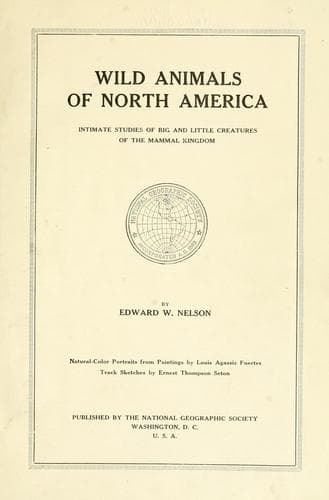
Wild Animals of North America: Intimate Studies of Big and Little Creatures of the Mammal KingdomNelson, Edward William
Science
Wild Animals of North America: Intimate Studies of Big and Little Creatures of the Mammal Kingdom
Nelson, Edward William
Mammals -- North America
The gray and fox squirrels were favorite targets for pioneer marksmen.
The early chronicles tell of the ability of Daniel Boone and other
riflemen to “bark” a squirrel, which meant so to cut the bark of the
branch on which the squirrel sat as to bring it to the ground stunned
without hitting the animal. With the clearing away of the forests,
the general occupation of the country, and the decrease of larger
animals, gray squirrels have been deprived of most of their haunts and
have become such desirable game that they have decreased to a point
requiring stringent legal protection to save them from extermination.
Gray squirrels are more thoroughly arboreal than red squirrels and
make their nests either in hollow trunks or build them in the tops of
trees. These outside nests are common and much like a crow’s nest in
appearance except that they are generally more bulky and show more dead
leaves. They are built on a foundation of small sticks with a rounded
top of leaves, and are lined with shreds of bark, moss, and similar
soft material. In the extreme northern part of their range they live
mainly in hollow trees, but farther south many winter in outside nests.
During severe cold and in stormy weather they remain hidden, sometimes
for days at a time.
They have two litters of four to six young a year, the first usually
being born in March or April. The old squirrel is a devoted mother and
if the nest is disturbed she will at once carry the young to some safer
retreat.
In many parts of their range black, or melanistic, individuals are born
in litters otherwise of the ordinary gray color. In some districts the
number of the black squirrels equals or exceeds the gray ones.
Gray squirrels range through such a variety of climatic conditions
that their food varies greatly. They eat practically all available
nuts, including acorns, chestnuts, beechnuts, hickory-nuts, and pecans,
besides numberless seeds, many small fruits, and mushrooms. They raid
fields for corn and wheat, and steal apples, pears, and quinces from
orchards to eat the seeds. Like most other small rodents, they are fond
of larvæ and insects and also destroy many birds’ eggs and young birds.
They are far less serious offenders, however, in destroying birds than
the red squirrel.
Public-domain text, read in full here on John Shaqi.
Reviews
Reviews
No reviews yet
Be the first to share your thoughts on this work.
Elsewhere in the archive
Join the Discussion
Join the discussion
Sign in to leave a comment or review.
Sign InorCreate an account