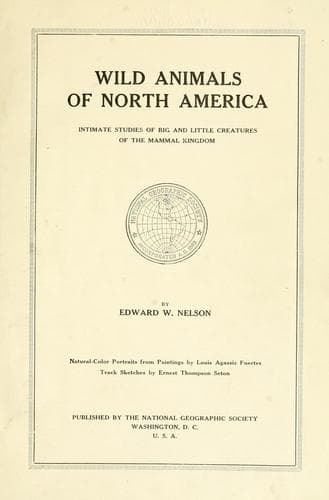
Wild Animals of North America: Intimate Studies of Big and Little Creatures of the Mammal KingdomNelson, Edward William
Science
Wild Animals of North America: Intimate Studies of Big and Little Creatures of the Mammal Kingdom
Nelson, Edward William
Mammals -- North America
On the approach of winter they lay up stores of seeds and nuts in
holes in trees and in little hiding places on the ground. Many nuts
are hidden away singly. In the public parks of Washington, where many
gray squirrels exist, I have repeatedly seen them dig a little pit
two or three inches deep, then push a nut well down it cover it with
earth, which they press firmly in place with the front feet, and then
pull loose grass over the spot. One squirrel will have many such hidden
nuts, and with nothing to mark the location it appears impossible that
they could be recovered. That the squirrels knew what they were doing
I have had repeated evidence in winter, even with several inches of
snow on the ground, when they have been seen sniffing along the top of
the snow, suddenly stop, dig down and unearth a nut with a precision
that demonstrates the marvelous delicacy of their sense of smell.
Although mainly diurnal, they are sometimes abroad on moonlight nights,
especially when gathering stores of food for winter.
Wherever they are, these squirrels are extremely graceful, moving
along the ground by curving bounds, the long fluffy tail undulating
as they go, or running through the tree-tops, leaping from branch to
branch with an ease and certainty beautiful to see. When pressed they
make amazing leaps from tree to tree or even from a high tree-top to
the ground without injury. They are extremely cunning at concealing
themselves by lying flat on top of branches or by gliding around tree
trunks, keeping them interposed between themselves and the pursuer.
Gray squirrels are so responsive to protection that they may continue
to grace our remaining forests if we properly guard them. In addition
to their beauty, they are interesting game animals which should
continue to afford a moderate amount of sport--sufficient to prevent
them from becoming overabundant and destructive. Now introduced in
many city parks throughout the United States and in parts of England,
including London, their ready acceptance of people as friends renders
them charming animals in such places; but natural food is so scarce
under these artificial conditions that care must be taken to feed them
at all seasons, especially in winter.
=THE FOX SQUIRREL= (=Sciurus niger= and its relatives)
(_For illustration, see page 547_)
THE RUSTY FOX SQUIRREL (Sciurus niger rufiventer)
(_For illustration, see page 547_)
Three species of tree squirrels inhabit the varied forests of eastern
North America, each having its marked individuality expressed in color,
size, and habits. All occupy a wide territory with varying climatic
conditions, to which each species has responded by becoming modified
into a series of geographic races, or subspecies. The red and the gray
squirrels have already been described and it remains to give an account
of the largest and in some respects the most remarkable of the three,
the fox squirrel.
Public-domain text, read in full here on John Shaqi.
Reviews
Reviews
No reviews yet
Be the first to share your thoughts on this work.
Elsewhere in the archive
Join the Discussion
Join the discussion
Sign in to leave a comment or review.
Sign InorCreate an account