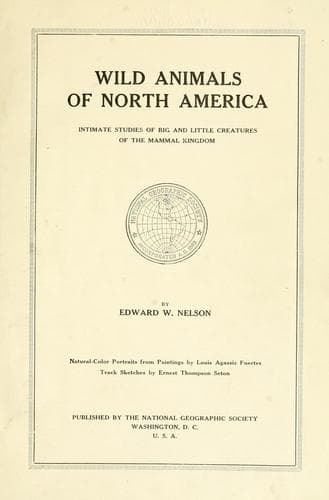
Wild Animals of North America: Intimate Studies of Big and Little Creatures of the Mammal KingdomNelson, Edward William
Science
Wild Animals of North America: Intimate Studies of Big and Little Creatures of the Mammal Kingdom
Nelson, Edward William
Mammals -- North America
No other species of North American mammal can show such an
extraordinary contrast in color among its subspecies as that between
the rusty yellowish animal of the Ohio and upper Mississippi Valleys,
and the handsome blackish one of the Southeastern States, both of which
are pictured in the accompanying illustration.
The distribution of the fox squirrel is limited to the forested parts
of the Eastern States. There it ranges from the Atlantic coast to the
border of the Great Plains, and from southern New York and the upper
Mississippi Valley southward to Florida, the Gulf coast, and across the
lower Rio Grande into extreme northeastern Mexico.
Variations in the character of the haunts of the different subspecies
of this squirrel almost equal their differences in color. In the
upper Mississippi and Ohio Valleys the rusty-colored race frequents
the upland woods, where the nut-bearing hickory trees characterize
the forests. In the South the dark-colored squirrels have more varied
homes, either amid the live oaks draped in long Spanish moss, in the
mysterious cypress forests of the swamps, or out in the uplands among
the southern pines.
[Illustration: RING-TAILED CAT
_Bassariscus astutus_]
[Illustration: OREGON MOLE
_Scapanus townsendi_]
[Illustration: STAR-NOSED MOLE
_Condylura cristata_]
In early days fox squirrels were plentiful, but never equaled the
numbers of the gray squirrel. They appear always to have been more
closely attached to their own district, for we have no records of the
great migrations so notable in the other species.
Fox squirrels are not only distinguished from gray squirrels by their
color, but are also nearly twice their size, commonly attaining a
weight of two and sometimes nearly three pounds. They are the strongest
and most heavily proportioned of all American squirrels. A deliberation
of movement going with heaviness of body is in marked contrast to the
graceful agility of most other tree squirrels. On the ground they walk
with a curiously awkward, waddling gait, and even when hard pressed
climb trees with none of the dashing quickness shown by other species.
They often move about on the ground by a series of bounds, and at such
times, with broad, feathery tails undulating in the air, present a most
graceful and attractive sight.
Fox and gray squirrels occupy the same districts throughout most of
their ranges, but often become so segregated locally that the grays may
be found almost exclusively along bottom-lands and the fox squirrels on
the higher ridges, but there is no hard and fast separation of haunts
and the two forms usually share the same woodlands.
Public-domain text, read in full here on John Shaqi.
Reviews
Reviews
No reviews yet
Be the first to share your thoughts on this work.
Elsewhere in the archive
Join the Discussion
Join the discussion
Sign in to leave a comment or review.
Sign InorCreate an account