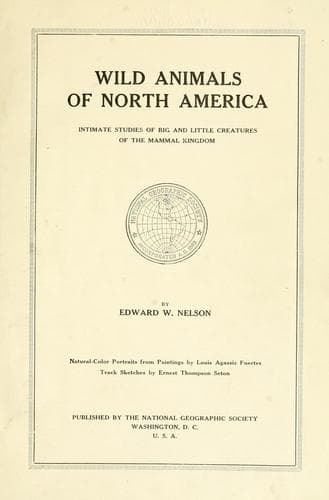
Wild Animals of North America: Intimate Studies of Big and Little Creatures of the Mammal KingdomNelson, Edward William
Science
Wild Animals of North America: Intimate Studies of Big and Little Creatures of the Mammal Kingdom
Nelson, Edward William
Mammals -- North America
They are as omnivorous as any of their kind, eating many kinds of
nuts, seeds, fruits, mushrooms, insects, birds, birds’ eggs, and other
flesh food when available. The principal nuts in their haunts are
hickory-nuts, beechnuts, walnuts, pecan nuts, and the seeds of pines
and cypresses. Toward the end of summer and in fall they work busily
gathering and storing food for winter in hollow trees, in old logs,
about the roots of trees, and in any other snug place where it may be
kept safely until needed. Many single nuts are buried here and there in
little pits three or four inches deep dug in the soft surface of the
earth under the trees. These scattered stores are located when needed
by the acute sense of smell which the owners possess.
=THE ABERT SQUIRREL= (=Sciurus aberti= and its subspecies)
(_For illustration, see page 550_)
THE KAIBAB SQUIRREL (Sciurus kaibabensis)
(_For illustration, see page 550_)
Among the many kinds of squirrels which lend animation and charm to
the forests of North and South America, none equal in beauty the
subjects of this sketch--the Abert and the Kaibab squirrels. These are
the only American squirrels endowed with conspicuous ear tufts, which
character they share with the squirrels occupying the forests in the
northern parts of the Old World from England to Japan. In weight they
about equal a large gray squirrel, but are shorter and distinctly more
heavily proportioned, with broader and more feathery tails.
Their range covers the pine-forested region of the southern Rocky
Mountains in the United States and the Sierra Madre of western Mexico.
The Abert squirrel and its several subspecies is the more widely
distributed, being found from northern Colorado, south through New
Mexico, Arizona, Chihuahua, and Durango. The Kaibab squirrel, which
is even more beautiful than its relative, shows marked differences in
appearance and yet is evidently derived from the same species.
The typical Abert squirrel lives in the pine forests along the southern
rim of the Grand Canyon in northern Arizona, and the Kaibab squirrel
lives in the pines visible on the northern rim of the canyon less than
15 miles away. It is confined to an islandlike area of pine forest
above 70 miles long by 35 miles wide, on the north side of the canyon,
on the Kaibab and Powell plateaus, directly across from the end of
the railroad at the Grand Canyon Hotel. The two species live under
practically identical conditions as to vegetation and climate.
In these sketches of our mammal life I have repeatedly noted the effect
of changing environment in modifying the animals subject to it. In
the present case the change in the squirrels on the north side of the
Grand Canyon has evidently been brought about by that powerful factor
in evolution known as isolation. Cut off from their fellows by the
deepening canyon of the Colorado, Kaibab squirrels have occupied a
forest island ever since, with the resulting change in characters we
now have in evidence.
Public-domain text, read in full here on John Shaqi.
Reviews
Reviews
No reviews yet
Be the first to share your thoughts on this work.
Elsewhere in the archive
Join the Discussion
Join the discussion
Sign in to leave a comment or review.
Sign InorCreate an account