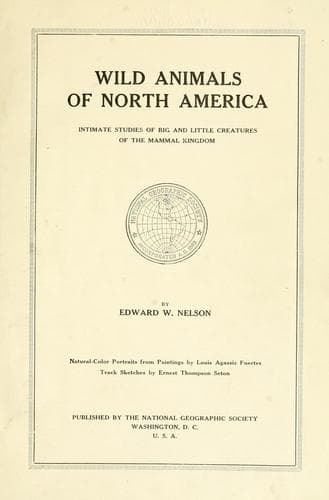
Wild Animals of North America: Intimate Studies of Big and Little Creatures of the Mammal KingdomNelson, Edward William
Science
Wild Animals of North America: Intimate Studies of Big and Little Creatures of the Mammal Kingdom
Nelson, Edward William
Mammals -- North America
The home of both the Abert and the Kaibab squirrels is almost entirely
between 6,000 and 9,500 feet altitude, on the mountain slopes and high
plateaus overgrown with a splendid open forest of yellow pine mixed in
many places with firs and aspens. Occasionally, as food becomes scarce
in their ordinary haunts, they range up into the firs or down into the
oaks and piñon pines. In winter their haunts are buried in snow, but
in summer on every hand present lovely vistas among the massive tree
trunks, varied here and there by gemlike parks. Everywhere the ground
is covered with grasses and multitudes of flowering plants. In the
wilder parts of this fascinating wilderness roam bears, mountain lions,
wolves, deer, and wild turkeys, and only a few decades ago still wilder
men, belonging to some of our most dreaded Indian tribes.
Although these squirrels commonly make use of large knot-holes or other
hollows in trees, they regularly build high up in the branches bulky
nests of leaves, pine needles, and twigs and line them with soft grass
and shredded bark. Sometimes several full-grown squirrels may be found
occupying one of these outside nests, probably members of one family.
They are active throughout the year, but remain in their nests during
storms and severe winter weather. In northern Arizona I have known them
to stay under cover for a week or two at a time in midwinter.
The young appear to be born at varying times between April and
September. Although not definitely known, it seems probable that they
have two litters of from three to four young each season.
The seeds and the tender bark from the terminal twigs of the yellow
pine (_Pinus ponderosa_) furnish their principal food supply. During
periods when pine seeds are not available the squirrels cut the ends
of pine twigs, letting the terminal part bearing the leaves fall to
the ground, while the stem, several inches in length, is stripped of
bark. Often at times of food scarcity the bark will be eaten for a
considerable distance along the outer branches, almost like the work of
porcupines. The ground under the pines where the squirrels are at work
is sometimes almost covered with the freshly dropped tips of branches.
The Abert squirrels also eat the seeds of Douglas spruce, of the piñon
pine, acorns, many seeds, roots, green vegetation, mushrooms, birds’
eggs, and young birds. Now and then they rob cornfields planted in
clearings, but they do little damage to crops. Some years they are
extremely numerous and are in evidence everywhere; again they become
scarce and so wary that it is difficult to see one, even where its
fresh workings are in evidence.
Public-domain text, read in full here on John Shaqi.
Reviews
Reviews
No reviews yet
Be the first to share your thoughts on this work.
Elsewhere in the archive
Join the Discussion
Join the discussion
Sign in to leave a comment or review.
Sign InorCreate an account