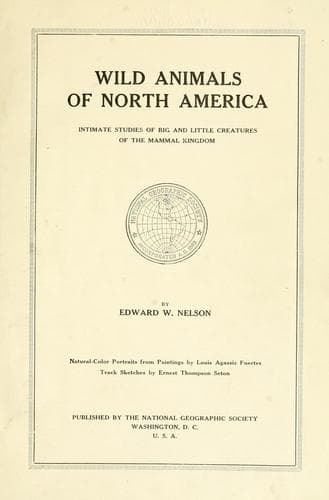
Wild Animals of North America: Intimate Studies of Big and Little Creatures of the Mammal KingdomNelson, Edward William
Science
Wild Animals of North America: Intimate Studies of Big and Little Creatures of the Mammal Kingdom
Nelson, Edward William
Mammals -- North America
One summer day in the Sierra Madre of western Durango I sat on a
mountain slope watching for game. Below me stood the hollow-topped stub
of an oak, the top being on a level with my eyes and about twenty yards
away. Soon after I arrived the heads of four half-grown squirrels of
the Abert family appeared in a row at the upper border of the opening,
their bright eyes turning on all sides. Suddenly a hawk glided by, one
of its wing tips almost brushing the noses of the squirrels. Instantly
they vanished from sight and a noise of scratching and frightened
chattering continued for several minutes, as though they were burying
themselves under the nest. About twenty minutes later the boldest of
the family showed the tip of his nose at an opening in a hollow branch
near the top of the stub, but it required another ten minutes for him
to venture forth his head. Finally, becoming confident that no danger
threatened, he came out on the limb and deliberately stretched himself,
yawning as widely as his little mouth would permit, after which he
flirted his tail and frisked over to the trunk of the stub, where he
began frolicking about with all the abandon of a kitten at play. When I
departed his more timorous companions were still peering fearfully out
of the hole, anticipating the return of the dreaded hawk.
=THE FLYING SQUIRREL= (=Glaucomys volans= and its relatives)
(_For illustration, see page 551_)
No one can see one of our small flying squirrels in life without
being charmed by its delicate grace of form and velvety fur, nor fail
to note the large black eyes which give it a pleasing air of lively
intelligence. Flying squirrels are distinguished from all other members
of the squirrel family by extensions of the skin along the sides, which
unite the front and hind legs, so that when the animal leaps from some
elevated point with legs outspread the membrane and the underside of
the body present a broad, flat surface to the air. This enables it to
glide swiftly down in a diagonal course toward a tree trunk or other
vertical surface on which it desires to alight. It is able to control
its movements and to turn with ease to one side or the other, or upward
before alighting. When gliding down a wooded hillside or through thick
growths of timber, it is thus able to avoid obstacles and alight on the
desired place.
Public-domain text, read in full here on John Shaqi.
Reviews
Reviews
No reviews yet
Be the first to share your thoughts on this work.
Elsewhere in the archive
Join the Discussion
Join the discussion
Sign in to leave a comment or review.
Sign InorCreate an account