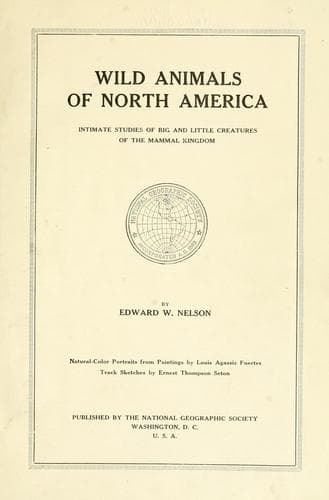
Wild Animals of North America: Intimate Studies of Big and Little Creatures of the Mammal KingdomNelson, Edward William
Science
Wild Animals of North America: Intimate Studies of Big and Little Creatures of the Mammal Kingdom
Nelson, Edward William
Mammals -- North America
Both these squirrels have a deep churring or chucking call, sometimes
becoming a barking note resembling that of the fox squirrel. They also
have a variety of chattering and scolding notes when excited or angry.
At times they become almost as aggressive as the red squirrel and come
down the tree trunk or to a lower branch, whence they scold and berate
the object of their disapproval.
When much alarmed they are expert at hiding among tufts of leaves near
the ends of branches, on tops of large limbs, or behind trunks. They
will remain hidden in this way for an hour or more, patiently waiting
for the danger to disappear, but one is often betrayed by the wind
blowing the feathery tip of its tail into view.
On the ground the tail is usually carried upraised in graceful curves.
Here these squirrels spend much time among fallen cones and in digging
for roots and other food. When they walk they have an awkward waddling
gait, but when they are alarmed, or desire to move more rapidly for any
cause, they progress in a series of extremely graceful bounds, which
show the plumelike tail to good advantage. When the Kaibab squirrel
is moving about on the ground its great white tail is extraordinarily
conspicuous in the sunshine. This repeatedly drew my attention to these
squirrels, even at such long distances that they would otherwise have
been overlooked.
[Illustration: SHORT-TAILED SHREW
_Blarina brevicauda_
COMMON SHREW
_Sorex personatus_]
[Illustration: HOARY BAT
_Nycteris cinereus_
RED BAT
_Nycteris borealis_]
Although so heavily built, these squirrels are adept in leaping from
branch to branch and from tree to tree. On one occasion a branch on
which an Abert squirrel was standing near the top of a pine tree was
struck by a rifle ball; the squirrel promptly ran to the end of a
large branch about fifty feet from the ground, and although no tree
was anywhere near on that side, leaped straight out into the air, with
its legs outspread just as in a flying squirrel. It came down in a
horizontal position and struck the ground flat on its under side and
the rebound raised it several inches. Without an instant’s delay it was
running at full speed across a little open park and disappeared in the
forest on the other side. I was standing only a few yards to one
side of the falling squirrel and the widely spread feet and legs were
perfectly outlined against the sky. It was evident that this squirrel
and probably all of its kind appreciate that such an attitude will
help break the force of the descent. This suggested the possibility of
a similar habit having influenced the origin of the flying squirrel’s
membranes.
[Illustration: BIG-EARED DESERT BAT
_Antrozous pallidus_]
[Illustration: MEXICAN BAT
_Nyctinomus mexicanus_]
Public-domain text, read in full here on John Shaqi.
Reviews
Reviews
No reviews yet
Be the first to share your thoughts on this work.
Elsewhere in the archive
Join the Discussion
Join the discussion
Sign in to leave a comment or review.
Sign InorCreate an account