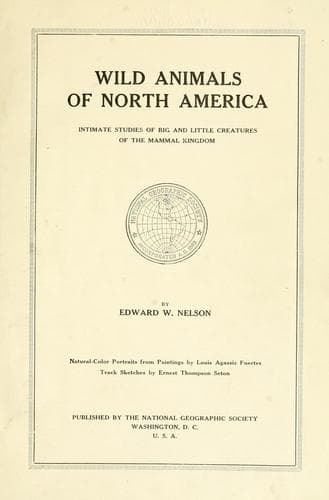
Wild Animals of North America: Intimate Studies of Big and Little Creatures of the Mammal KingdomNelson, Edward William
Science
Wild Animals of North America: Intimate Studies of Big and Little Creatures of the Mammal Kingdom
Nelson, Edward William
Mammals -- North America
When reduced to scale, the large tracks on the left side are life size,
showing the animal making the ordinary bounds of about 3 inches between
each set of tracks. In speeding, the space may increase to 12 inches.
The tail usually shows in the deermouse track, and this, with the
pairing of the fore paws, is a strong characteristic (see pages 521 and
530).]
=THE LARGE WEASELS, OR STOATS= (=Mustela arcticus= and its
relatives)
(_For illustration, see page 554_)
The weasel family includes not only the true weasels, but numerous
other carnivores, as the sable or marten, mink, ferret, skunk, and land
and sea otters, all of which rank among our highly valued fur-bearers.
The large weasel may be distinguished from others of its family by
the small size and the snakelike proportions of the flattened and
pointed head, combined with a long, extremely slender neck and body
and a comparatively long tail. The best known of these animals are the
stoat of the northern parts of the Old World (_Mustela erminea_) and
its close relative in northern North America (_Mustela arcticus_), the
winter skins of which furnish the famed ermine, once sacred to the
trappings of royalty.
The northern weasels are strongly marked by their habit of changing
their brown coat to one of snowy white at the beginning of winter.
To the south the change becomes less complete as the winter snows
decrease, and south of the limit of snow the brown coat is retained
throughout the year. The time of change depends on the coming of the
snow and varies with the year, and the time of resumption of the
brown coat in spring depends in the same way on the season. The white
winter coat of the larger and medium-sized species is accompanied by a
strongly contrasting jet black tip to the tail.
Weasels are circumpolar in distribution and occupy nearly all parts
of Europe, Asia, and North and South America, the greatest number and
variety of species occurring in North America. Surprisingly enough, the
largest of these eminently northern animals is found in the forests
of the American tropics. The Arctic weasel ranges to the northernmost
polar lands of North America, where its presence has been recorded many
times by ice-bound explorers. Other species are more or less generally
distributed over the remainder of the continent. In Mexico I have found
them from sea level to above timberline, at more that 13,000 feet
altitude on the high volcanoes.
The strong personality of the weasels as a group is based mainly on
their extraordinary celerity of movement, their courage, and their
insatiable desire to kill. They are not satisfied with supplying the
call for food, but whenever opportunity arises kill from sheer lust of
slaughter.
Public-domain text, read in full here on John Shaqi.
Reviews
Reviews
No reviews yet
Be the first to share your thoughts on this work.
Elsewhere in the archive
Join the Discussion
Join the discussion
Sign in to leave a comment or review.
Sign InorCreate an account