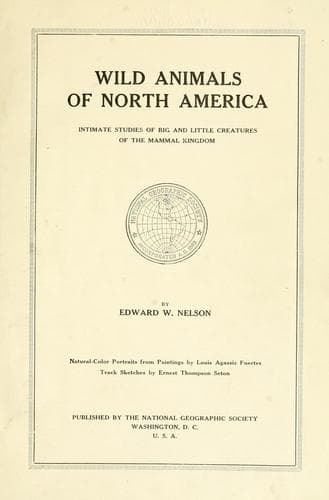
Wild Animals of North America: Intimate Studies of Big and Little Creatures of the Mammal KingdomNelson, Edward William
Science
Wild Animals of North America: Intimate Studies of Big and Little Creatures of the Mammal Kingdom
Nelson, Edward William
Mammals -- North America
Least weasels are characterized by the same swift alertness and
boldness so marked in the larger species. In fact they are, if
possible, even quicker in their movements. Once when camping in
spring among scattered snowbanks on the coast of Bering Sea, I had an
excellent opportunity to witness their almost incredible quickness.
Early in the morning one suddenly appeared on the margin of a snowbank
within a few feet, and after craning its neck one way and the other,
as though to get a better view of me, it vanished, and then appeared
so abruptly on a snowbank three or four yards away that it was almost
impossible to follow it with the eye. It was beginning to take on its
summer coat of brown and was extremely difficult to locate amid the
scattered patches of snow and bare moss of the tundra. Certainly no
other mammal can have such flash-like powers of movement.
They feed mainly on mice, lemmings, shrews, small birds, their eggs and
young, and insects. Mice furnish a large proportion of their prey and
weasels have often been seen following the runways of field mice. Their
small size enables them to pursue mice into their underground workings
as readily as a ferret enters a rabbit burrow. They also climb trees
and bushes with great agility, although nearly always seeking their
victims on the ground. The mice upon which they prey are often so much
larger than the weasels that they cannot be dragged into the dens. The
weasels continue in full activity throughout the winter and constantly
burrow into the snow in search of their prey. In the snow or in the
ground the holes of this animal are about the diameter of one’s finger.
In the Old World the small weasels are reported to have several litters
in a season, each containing five or six young. At Point Barrow,
Alaska, a female captured on June 12 still contained twelve embryos.
This indicates that only one litter a year would be born there, and
that _Mustela rixosa_ is more prolific than its European representative.
In the more southern latitude least weasels live in forests and about
farms, sheltering themselves under logs, brush piles, stone walls,
and similar cover. They are always restless and filled with curiosity
regarding anything of unusual appearance. When one encounters a man
it shows no fear, but slyly moving from one shelter to another, now
advancing and now retreating, examines the stranger carefully before
going on its way. As they devote practically their entire lives to the
destruction of field mice, they are valuable friends of the farmer
and should have his good will and protection. Unfortunately for these
weasels, no discrimination is shown between them and their larger
relatives of more injurious habits.
Public-domain text, read in full here on John Shaqi.
Reviews
Reviews
No reviews yet
Be the first to share your thoughts on this work.
Elsewhere in the archive
Join the Discussion
Join the discussion
Sign in to leave a comment or review.
Sign InorCreate an account