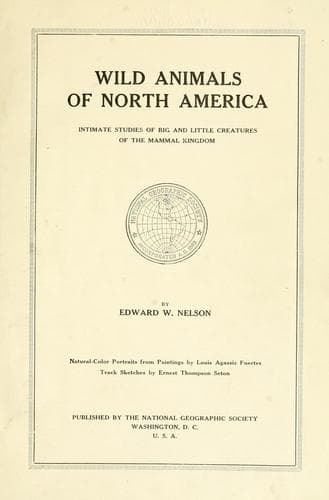
Wild Animals of North America: Intimate Studies of Big and Little Creatures of the Mammal KingdomNelson, Edward William
Science
Wild Animals of North America: Intimate Studies of Big and Little Creatures of the Mammal Kingdom
Nelson, Edward William
Mammals -- North America
Among the natives of Alaska all weasels are looked upon with great
respect on account of their prowess as hunters. I found this feeling
peculiarly strong among the Eskimos, whose existence for ages has
depended so largely on the products of the chase. Among them the
capture of a weasel meant good luck to the hunter, and to take the
rarer least weasel was considered a happy omen. The head and entire
skin of the least weasel was highly prized for wearing as an amulet or
fetich. Young men eagerly purchased them, paying the full value of a
prime marten skin in order to wear them as a personal adornment, that
they might thus become endowed with the hunting prowess of this fierce
little carnivore. Fathers often bought them to attach to the belts of
their small sons, so that the youthful hunters might become imbued with
the spirit of this “little chief” among mammals.
=THE AMERICAN MINK= (=Mustela vison= and its relatives)
(_For illustration, see page 555_)
In the American mink we have one of the most widely known and valuable
fur-bearers of the weasel family. It is a long-bodied animal, but
more heavily proportioned than the weasel, and attains a weight of
from one and one-half to more than two pounds. It has short legs and
walks slowly and rather clumsily with the back arched. When desiring
to travel rapidly it moves in a series of rapid easy bounds which it
appears able to continue tirelessly.
[Illustration: THE TRACK OF A FOX
The size, the small pads, and the set of all feet nearly in one line
are strong features, as also is the tail touch.]
The minks form a small group of species circumpolar in distribution,
and well known in Europe, northern Asia, and in North America. The
European animal is closely similar to the North American species and
all have the same amphibious habits. The American minks include several
different geographic races, which are distributed over all the northern
part of the continent from the Atlantic to the Pacific and from the
mouths of the Yukon and Mackenzie Rivers to the Gulf coast in the
United States. They are absent from the arid Southwestern States.
Few species are more perfectly adapted to a double mode of life
than the mink. It is equally at home slyly searching thickets and
bottom-land forests for prey or seeking it with otter-like prowess
beneath the water. It is a restless animal, active both by day and by
night, although mainly nocturnal.
While usually having definite dens to which they return, minks wander
widely and for so small an animal hunt over a large territory and pass
from one body of water to another. Their wanderings are most pronounced
in fall and again during the mating in spring. They are solitary, their
companionship with one another not outliving the mating period.
Public-domain text, read in full here on John Shaqi.
Reviews
Reviews
No reviews yet
Be the first to share your thoughts on this work.
Elsewhere in the archive
Join the Discussion
Join the discussion
Sign in to leave a comment or review.
Sign InorCreate an account