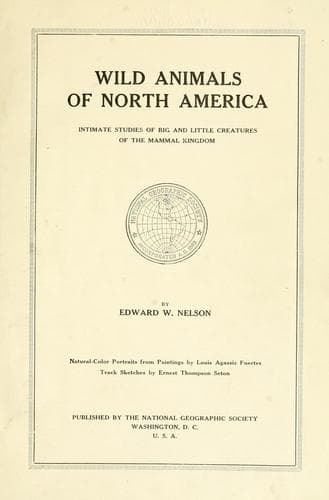
Wild Animals of North America: Intimate Studies of Big and Little Creatures of the Mammal KingdomNelson, Edward William
Science
Wild Animals of North America: Intimate Studies of Big and Little Creatures of the Mammal Kingdom
Nelson, Edward William
Mammals -- North America
Their diet is fully as varied as that of others of the weasel kind, but
is made up mainly of insects and other forms injurious to agriculture,
including grasshoppers, crickets, beetles, and larvæ of many kinds.
They feed also on flesh whenever possible and prey on wood rats, mice
of many kinds, small ground squirrels, small birds and their eggs,
young chickens, lizards, salamanders, and crawfish. This carnivorous
diet is further varied with mushrooms, peanuts, persimmons, cactus
fruit, and other small fruits. Sometimes the animals locate about
occupied habitations in primitive communities, where they give good
service by killing the house rats, mice, and cockroaches on the
premises. On one occasion a spotted skunk was detected cunningly
removing the downy chicks from under a brooding hen without disturbing
her.
In comparison with the other skunks these little animals are extremely
agile. They are strictly nocturnal and when pursued at night by dogs
will climb to safety in a tree like a squirrel. When caught in a trap
they struggle and fight far more vigorously than their big relatives.
They usually carry the tail in a somewhat elevated position, but when
danger threatens hold it upright like a warning signal. If the enemy
fails to take heed they shoot two little spraylike jets of liquid
bearing the usual offensive skunk odor, and the victim retires without
honor.
In writing of these skunks about the Valley of Mexico, in 1628, Dr.
Hernandez tells us that “the powerful arm which they use when in
peril is the insupportable gas they throw out behind which condenses
the surrounding atmosphere so that, as one grave missionary says, it
appears as though one could feel it.”
That the little spotted skunk is subject to rabies and has communicated
it to many men in the West is unquestionable. It usually bites men who
are sleeping on the ground in its haunts, as they commonly do on the
western stock ranges.
I have personally known of several instances in northern Arizona of
men being bitten by them. The head, face, and hands, being uncovered,
are the points attacked. One man in the mountains south of Winslow,
Arizona, was bitten on the top of his head in April, 1910, but paid no
attention to the slight wound until two months later when he began to
have spasms. He then hurried to town and died in great agony the next
day. The year following a man in the same district was bitten in the
face, and seizing the animal threw it from him in such a manner that it
fell on his brother and bit him before he awakened. Both men were given
the Pasteur treatment and had no further trouble.
Public-domain text, read in full here on John Shaqi.
Reviews
Reviews
No reviews yet
Be the first to share your thoughts on this work.
Elsewhere in the archive
Join the Discussion
Join the discussion
Sign in to leave a comment or review.
Sign InorCreate an account