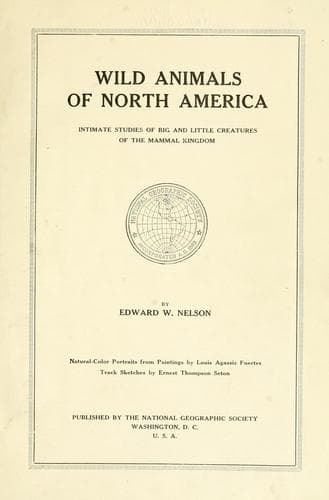
Wild Animals of North America: Intimate Studies of Big and Little Creatures of the Mammal KingdomNelson, Edward William
Science
Wild Animals of North America: Intimate Studies of Big and Little Creatures of the Mammal Kingdom
Nelson, Edward William
Mammals -- North America
The skunks form a distinct section of the weasel family, limited to
North and South America. The group is divided into three well-marked
sections. One of these, the little spotted skunks, is distinguished
from all other mammals by the curious and pleasing symmetry of the
black and white markings of the animals. Few more beautiful fur
garments are made than those from the skins of these animals in their
natural colors. These skunks are smaller than any members of the other
groups, varying from a little larger than a large chipmunk to the size
of a fox squirrel.
[Illustration: THE COMMON WOODCHUCK, OR AMERICAN MARMOT (SEE PAGES
533-534)
Its track shows this animal’s kinship with the squirrels. The small
series, to the left, show the ordinary ambling pace. When speeding,
it sets its feet much like the little, or eastern, chipmunk (see page
580).]
Little spotted skunks include several species and geographic races. All
are limited to North America and are rather irregularly distributed
from the Atlantic coast to the Pacific and from Virginia, Minnesota,
Wyoming, and southern British Columbia southward to the Gulf coast, to
the end of Lower California, and through Mexico and Central America to
Costa Rica. They inhabit a variety of climatic conditions, from the
rocky ledges high up on the slopes of the western mountains to the hot
desert plains of the Southwest, and to partly forested regions in both
temperate and tropical lands. In different parts of the United States
they have several other names, including “civet,” “civet cat,” and
“hydrophobia skunk.”
The spotted skunks make their homes in whatever shelter is most
convenient, whether it be clefts in rocky ledges, slide rock, hollows
in logs or stumps, holes dug by themselves in banks or under the
shelter of cactuses or other thorny vegetation, the deserted holes of
burrowing owls in Florida, or the old dens of various kinds of mammals
elsewhere. Thickets, open woods, ocean beaches, and the vicinity of
deserted or even occupied buildings on ranches are equally welcome
haunts. On the plains of Arizona they have been known to live inside
the mummified carcass of a cow, the sun-dried hide of which made an
impregnable cover. They have a single litter of from two to six young
each year.
Public-domain text, read in full here on John Shaqi.
Reviews
Reviews
No reviews yet
Be the first to share your thoughts on this work.
Elsewhere in the archive
Join the Discussion
Join the discussion
Sign in to leave a comment or review.
Sign InorCreate an account