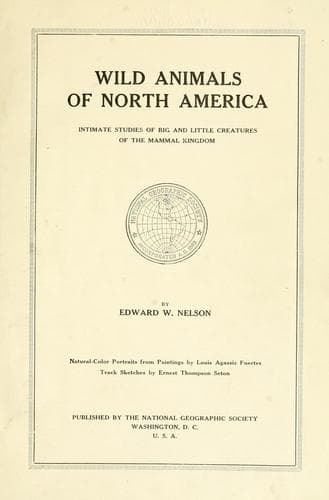
Wild Animals of North America: Intimate Studies of Big and Little Creatures of the Mammal KingdomNelson, Edward William
Science
Wild Animals of North America: Intimate Studies of Big and Little Creatures of the Mammal Kingdom
Nelson, Edward William
Mammals -- North America
On another occasion in the mountains of San Luis Potosi, on the Mexican
table-land, I found a spring to which bears were coming for water at
night. As the bears here appeared to be strictly nocturnal. I ensconced
myself in the evening with a dark lantern, amid some small bushes,
against a large pine log which sloped downward to the bottom of the
gulch near the spring, with the plan to welcome any bears which might
come in. An hour or more after dark the clinking rattle of small stones
on the far side of the gulch indicated the presence of some animal. The
light from the lantern was flashed on the spot and the rifle lowered
with exasperation as, running back and forth, turning over stones in
search of insects, a spotted skunk was revealed. The movements of this
unwelcome visitor were extremely light and graceful, and in my interest
in watching them, for a time I forgot the bear. Two or three hours
passed and the skunk tired of the hillside and came down to the spring,
where he found the offal from a deer which I had placed there for bait.
This gave him more to do, and after I had listened to him worry the
meat for awhile, I turned on the light and was entertained by the sight
thus revealed. The skunk appeared to have a persistent desire to drag
away the offal many times his weight. He would seize the edge of one of
the lungs and after a hard struggle would get it up on one edge, when
the burden would turn over with a flap, whirling the skunk flat on his
back each time. Immediately scrambling to his feet, he would give the
meat a fierce shake of resentment and repeat the performance.
After a long time the moon arose and the skunk could be plainly seen
running back and forth playfully, now biting at the meat and now
turning over stones apparently in sheer exuberance of spirit. Then he
suddenly mounted the lower end of the log and came galloping up it
until he was close to my shoulder. There he stopped and, coming as near
as possible, extended his nose within a few inches of my face, and
for minute or more stood trying to satisfy himself about this strange
object. Satisfied at last, he turned and galloped back down the log
and resumed his antics in the gulch, finally working close to the
bank three or four yards below me. There he found many small stones
and had a fine time rattling them about until I decided that with
this disturbing presence I should have little chance for other game.
Finding a convenient stone, and locating the skunk as well as possible
from the sounds, I tossed it over to try and frighten him away. My
aim was too true, for the characteristic skunk retort filled the air
with suffocating fumes and I immediately lost interest in further bear
hunting.
[Illustration: THE TRAIL OF THE EASTERN CHIPMUNK
The track is much like that of the fox squirrel, but usually the fore
feet are a little, or quite, one behind the other and, of course, much
smaller. No tail mark is ever seen (see pages 542 and 549).]
Public-domain text, read in full here on John Shaqi.
Reviews
Reviews
No reviews yet
Be the first to share your thoughts on this work.
Elsewhere in the archive
Join the Discussion
Join the discussion
Sign in to leave a comment or review.
Sign InorCreate an account