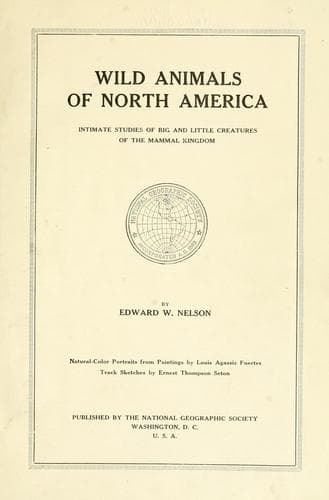
Wild Animals of North America: Intimate Studies of Big and Little Creatures of the Mammal KingdomNelson, Edward William
Science
Wild Animals of North America: Intimate Studies of Big and Little Creatures of the Mammal Kingdom
Nelson, Edward William
Mammals -- North America
=THE COMMON SKUNK= (=Mephitis mephitis= and its relatives)
(_For illustration, see page 558_)
Probably no American mammal is more generally known and less popular
than the skunk. This current odium is due wholly to its possession
of a scent sac of malodorous fluid, which it distributes with prompt
accuracy when annoyed. The possession of this method of defense is
common to all skunks. The term “pole-cat,” sometimes given to all kinds
of skunks, is the misuse of a name given Old World martens of several
species and to the Cape pole-cat, a South African animal which in form
and markings, including the plumelike tail, is remarkably like some of
our smaller skunks.
In the preceding article an account was given of the spotted skunks,
smallest of the three groups into which these animals are divided. The
common skunk and its relatives form another group, which contains some
of the larger species of their kind, some of them weighing up to ten
pounds or more. These are the typical skunks, so familiar in most parts
of the United States, and distinguished by the disproportionately large
size of the posterior half of the body and the long, plumelike tail.
The common skunk, with its closely related species, is generally
distributed in all varieties of country, except in deep forests and
on waterless desert plains. It ranges from the Atlantic coast to the
Pacific and from Hudson Bay and Great Slave Lake southward to the
highlands of Guatemala. The vertical range extends from sea-level up to
above timberline in Mexico, where I found one living in a burrow it had
dug under a rock at 13,800 feet altitude on the Cofre de Perote, Vera
Cruz.
Skunks are most common in areas of mixed woodland and fields, in valley
bottoms, and along the brushy borders of creeks and rocky canyons.
One of their marked characteristics is a fondness for the vicinity of
man. They frequently visit his premises, taking up quarters beneath
outbuildings or even under the house itself.
Any convenient shelter appears to satisfy them for a home, and they
will occupy the deserted burrows of other animals, small cavities among
the rocks, a hollow log, or a hole dug by themselves. A warm nest
of grass and leaves is made at the end of the den, where the single
litter of young, containing from four to ten, is born in April or May.
As soon as the young are old enough they follow the mother, keeping
close behind her, often in a long single file along a trail. They are
mainly nocturnal, but in summer the mother frequently starts out on
an excursion with her young an hour or two before sunset and they may
remain abroad all night.
Public-domain text, read in full here on John Shaqi.
Reviews
Reviews
No reviews yet
Be the first to share your thoughts on this work.
Elsewhere in the archive
Join the Discussion
Join the discussion
Sign in to leave a comment or review.
Sign InorCreate an account