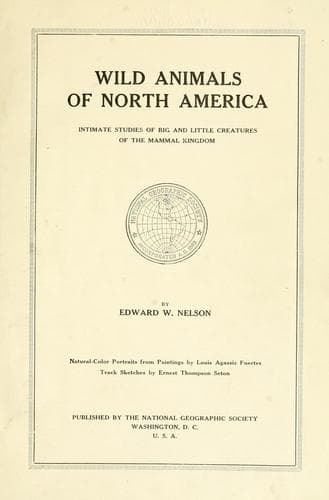
Wild Animals of North America: Intimate Studies of Big and Little Creatures of the Mammal KingdomNelson, Edward William
Science
Wild Animals of North America: Intimate Studies of Big and Little Creatures of the Mammal Kingdom
Nelson, Edward William
Mammals -- North America
When mildly annoyed the big skunks stamp their front feet on the ground
and utter little growls of displeasure. By some effort they can be
urged into a retreat which may take the form of a clumsy gallop. They
are known occasionally to swim streams voluntarily, and even to cross
rivers, probably urged by the instinct that so often forces animals of
all kinds to move to new feeding grounds.
Although usually safe from annoyance through the protective armament,
many skunks, especially the young, each year fall victim to natural
enemies, including wolves, coyotes, foxes, badgers, and great horned
owls.
The flesh of the skunk is a favorite food among certain tribes of
Canadian Indians, and many white men have pronounced it exceedingly
palatable, even claiming its superiority over the flesh of domestic
fowls. In the narrative of his expedition through the Canadian
wilderness many years ago, the naturalist Drummond recorded that when
the party was about a day’s journey from Carleton House it had the good
fortune to kill a skunk, “which afforded us a comfortable meal.” In the
Valley of Mexico I found the natives prize the flesh of these animals
as a cure for a certain loathsome disease.
It is well known that large skunks are often extremely fat. The oil
produced from them is clear and is said to have unusually penetrating
qualities. For many years there was a demand for this oil for various
medicinal purposes.
During recent years the fur of skunks has come into great demand, and
good prices are paid for prime skins. The animals are so numerous and
the catch is so large that they now rank among the most valuable of our
fur-bearers. They are gentle animals which readily become domesticated
and breed freely in confinement, and many efforts are being made to
establish skunk farms. Success in such farming depends wholly on the
outlay for upkeep. Skunk farming will probably pay better as a side
line, like chickens on the ordinary farm, than to establish regular fur
farms. The scent sac may be removed by a slight surgical operation, so
there need be no trouble from that source. Common skunks when taken
young make affectionate and entertaining pets. They become as tame and
playful as kittens, and are vastly more intelligent and interesting.
=THE HOG-NOSED SKUNK= (=Conepatus mesoleucus= and its
relatives)
(_For illustration, see page 559_)
Public-domain text, read in full here on John Shaqi.
Reviews
Reviews
No reviews yet
Be the first to share your thoughts on this work.
Elsewhere in the archive
Join the Discussion
Join the discussion
Sign in to leave a comment or review.
Sign InorCreate an account