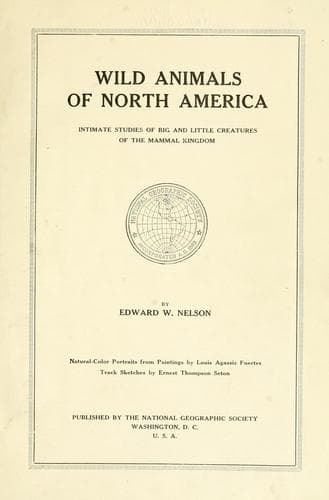
Wild Animals of North America: Intimate Studies of Big and Little Creatures of the Mammal KingdomNelson, Edward William
Science
Wild Animals of North America: Intimate Studies of Big and Little Creatures of the Mammal Kingdom
Nelson, Edward William
Mammals -- North America
The third and last group of skunks contains a number of species showing
well-marked differences from the two groups already described. The
species vary in size, but among them is included the largest of all
skunks. All are characterized by comparatively short hair, especially
on the tail, and this appendage lacks the plumelike appearance observed
in other skunks. The nose is prolonged into a distinct “snout,” naked
on the top and sides and evidently used for rooting in the earth after
the manner of a pig. In addition, the front feet are armed with long,
heavy claws, and the front legs and shoulders are provided with a
strong muscular development for digging, as in a badger. This likeness
has led to the use in some places of the appropriate name “badger
skunk” for these animals. The single white stripe along the back, and
including the tail, is a common pattern with these skunks, but this
marking is considerably varied, as in the common species.
[Illustration: WOLVERINE
Its weasel kinship is seen in the wolverine track. Occasionally, not
always, its fifth toe shows. The track is not plantigrade, and a single
track is easily mistaken for that of a wolf.]
The hog-nosed skunks are the only representatives of the skunk tribe
in South America, where various species occupy a large part of the
continent. They appear to form a South American group of mammals which
has extended its range northward through Central America, Mexico, and
across the border of the United States to central Texas, New Mexico,
and Arizona. In Mexico they range from sea-level to above 10,000 feet
altitude on the mountains of the interior.
The hair on these skunks is coarse and harsh, lacking the qualities
which render the coats of their northern relatives so valuable. Where
their range coincides with that of the common skunks, the local
distribution of the two is practically the same. They live along the
bottom-lands of watercourses, where vegetation is abundant and the
supply of food most plentiful, or in canyons and on rocky mountain
slopes.
For shelter they dig their own burrows, usually in a bank, or under a
rock, or the roots of a tree, but do not hesitate to take possession
of the deserted burrows of other animals, or of natural cavities among
the rocks. Owing to their strictly nocturnal habits, they are much less
frequently seen than the common skunks, even in localities where they
are numerous. In fact it is only within the last few years that their
presence in many parts of the southwestern border has become known.
[Illustration: THE TRACK OF THE WEASEL
The unusual space between the fore and hind feet in the middle of
the left series is often seen. Sometimes the tail mark is there and
sometimes not. Sometimes the trail is like that of a small mink. The
toes seldom show (see pages 554 and 572).]
Public-domain text, read in full here on John Shaqi.
Reviews
Reviews
No reviews yet
Be the first to share your thoughts on this work.
Elsewhere in the archive
Join the Discussion
Join the discussion
Sign in to leave a comment or review.
Sign InorCreate an account