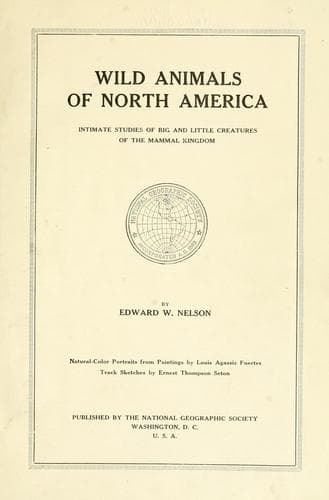
Wild Animals of North America: Intimate Studies of Big and Little Creatures of the Mammal KingdomNelson, Edward William
Science
Wild Animals of North America: Intimate Studies of Big and Little Creatures of the Mammal Kingdom
Nelson, Edward William
Mammals -- North America
Ring-tailed cats regularly locate among rocky ledges, neighboring
orchards, or other cultivated areas where they may gather some of the
bounty provided by man. I found them more plentiful among the broken
lava cliffs bordering date palm orchards in Lower California than in
any other place. When the dates were ripening they prowled about under
the palms after dark with gray foxes and spotted skunks to pick up the
fallen fruit. They sometimes uttered a complaining cry and when caught
in a trap would bark almost like a little dog, or occasionally utter a
vicious scream of mixed fear and rage.
Being an intelligent animal, the cacomixtle is readily tamed and makes
a most interesting pet. During the early years of gold mining in
California, when many men were living in rude cabins in the mountains,
the prevalence of mice often attracted these “cats” to take up their
residence there. Often the owner of the premises and the mouser struck
up a friendly relationship and the cacomixtle, becoming as free and
friendly about the place as a real cat, kept it entirely clear from
mice. I have had first-hand accounts of these tame individuals from
miners who had harbored them in this way for months. These accounts
always gave the impression that the animal was somewhat playful and
mischievous and most attractive to have about the premises. All agreed
that it was extremely fond of sugar.
[Illustration: TRACK OF THE OPOSSUM
The hand-like paws are unmistakable. The tail mark appears. The absence
of claw on the thumb of the hind foot is usually seen.]
=THE OREGON MOLE= (=Scapanus townsendi= and its relatives)
(_For illustration, see page 563_)
The effect on mammals of a narrowly specialized mode of life is well
illustrated in the mole. It is an expertly constructed living mechanism
for tunneling through the earth. The pointed nose, short neck,
compactly and powerfully built cylindrical body, with ribs strongly
braced to withstand pressure, and the short, paddlelike hands armed
with strong claws for digging are all fitted for a single purpose. Eyes
and ears are of little service in an underground life, so they have
become practically obsolete; the fur has been modified to a compact
velvety coat which will lie either front or back with equal facility
and thus relieve any friction from the walls of the tunneled roads, no
matter which way the animal travels.
Public-domain text, read in full here on John Shaqi.
Reviews
Reviews
No reviews yet
Be the first to share your thoughts on this work.
Elsewhere in the archive
Join the Discussion
Join the discussion
Sign in to leave a comment or review.
Sign InorCreate an account