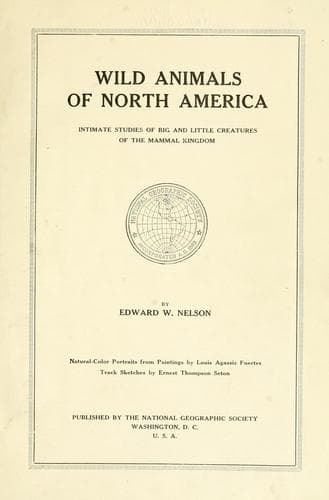
Wild Animals of North America: Intimate Studies of Big and Little Creatures of the Mammal KingdomNelson, Edward William
Science
Wild Animals of North America: Intimate Studies of Big and Little Creatures of the Mammal Kingdom
Nelson, Edward William
Mammals -- North America
In the Southwest they frequent some of the ruined cliff dwellings,
and I have found them haunting many of the ancient ruins of Mexico.
Their presence in little caves and other sheltered spots along cliffs
and rock walls bordering canyons or on mountain slopes may usually be
known by an examination of the fine dust which accumulates in sheltered
places. Whenever present their delicate cat-like tracks will be found
where they have been hunting mice or other small game.
Strictly nocturnal, they do not sally forth from their dens until
darkness is complete. During the night they are restless and frequently
wander far and wide in search of food, and apparently at times merely
to satisfy a spirit of inquiry. Their inquisitive nature frequently
leads them to explore the streets of towns and cities on the Mexican
table-land, filled though these places are with dogs. At daybreak,
tracks left in the dusty streets tell the story of their wanderings, as
they often do also in the case of opossums.
[Illustration: AMERICAN MINK TRACK NEARLY NATURAL SIZE
Although this animal has five toes on each foot, only four appear in
each track. This illustration, which is practically natural size, shows
the usual arrangement of the track. The hind feet are, of course, in
advance. Variations of arrangement are shown on the opposite page (see
also pages 555 and 575).]
One morning in February, 1893, soon after sunrise, I chanced to pass
through a little wooded square in the City of Mexico and saw a lot of
boys pursue and capture one of these animals which, having overstayed
his time, had been surprised by daybreak. This wanderer might have
had its den in some house in the neighborhood, since one of its known
habits is to take up its abode about houses, even in the midst of
towns. A friend living in the City of Mexico informed me that after
having been annoyed for some time by noises on the roof at night, he
investigated and discovered a female cacomixtle with partly grown young
snugly located in a nest placed in a narrow space between the tile roof
and the ceiling. In southern Texas the animals live on the brush-grown
plains under conditions very different from those usually chosen.
Like its relative the raccoon, the cacomixtle, with a taste for a
varied fare, takes whatever edibles come its way. It stalks wood rats,
mice, and even bats amid their rocky haunts and birds in bushes and
low trees. About the southern end of the Mexican table-land it is much
disliked for its robberies of chicken roosts, especially when these
are located in trees. Insects of many kinds, larvæ, and centipedes are
eaten, as well as a great variety of fruits, including that of the
pear-leaved cactus, and dates, figs, and green corn.
Public-domain text, read in full here on John Shaqi.
Reviews
Reviews
No reviews yet
Be the first to share your thoughts on this work.
Elsewhere in the archive
Join the Discussion
Join the discussion
Sign in to leave a comment or review.
Sign InorCreate an account