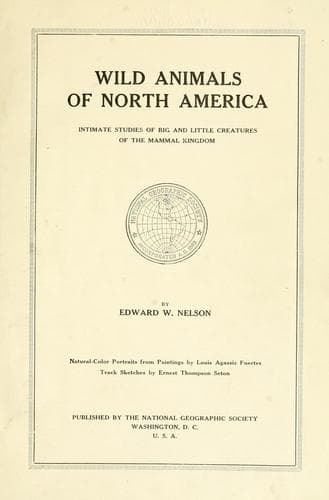
Wild Animals of North America: Intimate Studies of Big and Little Creatures of the Mammal KingdomNelson, Edward William
Science
Wild Animals of North America: Intimate Studies of Big and Little Creatures of the Mammal Kingdom
Nelson, Edward William
Mammals -- North America
They are most abundant in open grassy areas, especially in meadows and
in the bottoms of canyons and similar places, where the damp rich soil
affords a plentiful supply of earthworms, grubs, and insects on which
to feed. Like other moles, they lead lives of great activity and almost
constant hard labor. During damp weather they work near the surface,
but in dry periods as the upper soil hardens they follow their prey
to lower levels. A hard shower, however, always brings an outburst of
activity as they reoccupy the upper soil and throw up a multitude of
new mounds. They have the habit of regularly coming to the surface
to hunt food during the night. This is no doubt coincident with the
swarming up to the surface of earthworms on which the moles feed. At
such times many are captured by owls, cats, and other beasts of prey.
The runways of moles close along the surface, shown by well-marked
ridges, are for hunting purposes, and the lower tunnels, from which
the earth in the mounds is brought, are for traveling and lead to the
nest chamber. The deep tunnels of the Oregon mole sometimes extend
considerable distances along fences, or other surface cover, which
afford more or less protection. Such tunnels are a kind of highway
often used by several moles and also by shrews and field mice. The
system of tunnels of the moles over a considerable area often intersect
and are used more or less in common. As a result more than twenty moles
have been trapped at a single point in one of these underground roads.
They make an intricate system of many-branched tunnels, the courses
of which are usually marked by series of mounds varying from four to
ten inches high and five to twenty inches wide and often scattered
over meadows or other fields from two to six feet apart. Owing to
the persistence with which the moles raise their mounds everywhere
in the occupied parts of their territory, they have become a serious
and costly pest. In meadows the knives of mowing machines are dulled
by them, and in towns lawns are disfigured by their undesirable
activities. As a consequence they have now fallen under the ban and
are classed with other mammals which have shown their lack of ability
to fit in satisfactorily with the changed conditions brought to their
ancient territory by civilized man. Under natural conditions their
activities were undoubtedly entirely beneficial.
They appear to have but a single litter of young, numbering from one
to four, each year. These are born in March and grow so rapidly that
by the last of May they are working in the tunnels and are scarcely
distinguishable from the adults.
Public-domain text, read in full here on John Shaqi.
Reviews
Reviews
No reviews yet
Be the first to share your thoughts on this work.
Elsewhere in the archive
Join the Discussion
Join the discussion
Sign in to leave a comment or review.
Sign InorCreate an account