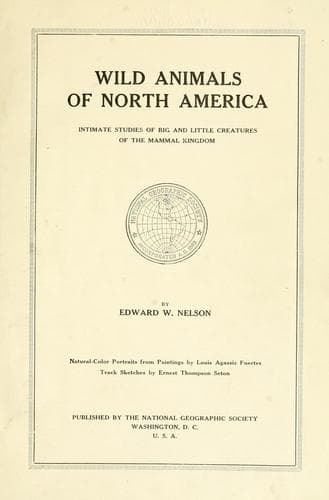
Wild Animals of North America: Intimate Studies of Big and Little Creatures of the Mammal KingdomNelson, Edward William
Science
Wild Animals of North America: Intimate Studies of Big and Little Creatures of the Mammal Kingdom
Nelson, Edward William
Mammals -- North America
The recent discovery that the Oregon moleskin is valuable for its fur
will give such an incentive to trapping that there is little doubt the
boys of the State within a few years will reduce the numbers of the
animal and thus control its injury to agriculture. The market for the
skins appears practically unlimited, judging by trade reports, one
dealer in Brooklyn stating that he dressed 4,000,000 imported European
moleskins in 1916.
THE STAR-NOSED MOLE (Condylura cristata)
(_For illustration, see page 563_)
The star-nosed mole, known in parts of Maine as the “gopher,” is
peculiar among the moles in having a fringe around the end of its nose
formed by twenty-two short fleshy tentacles. A less-marked character
is in the proportionately long tail, which becomes greatly enlarged in
fall and remains in this condition during the winter months. Otherwise
the external appearance of this species is much like that of the common
moles of America and the Old World.
The star-nosed mole is found from southern Labrador, the southern end
of Hudson Bay, and southeastern Manitoba south along the Atlantic coast
to Georgia and in the interior down the Alleghenies to North Carolina
and to Ohio, Indiana, Illinois, Wisconsin, and Minnesota. Throughout
this area it ranges irregularly and much yet remains to be learned
about the details of its distribution and habits.
Ordinarily solitary, these moles at times are so numerous in limited
areas that they appear to form colonies. Such gatherings probably mean
an unusually rich feeding ground, which makes it unnecessary for the
young to disperse to outlying locations, as is the habit of moles and
most other mammals.
The star-nosed mole has a strong preference for damp and even marshy
or swampy locations. It frequents low-lying meadows, the borders of
streams, and grassy swamps, where its underground burrows alternate
with open surface runways among grass roots and other matted
vegetation. It spends far more time above ground than the other
moles, and not infrequently swims among flooded cat-tails and other
vegetation and in winter has been seen swimming under the ice.
[Illustration: A RACCOON’S TRACK
The track of the raccoon is very distinctive and usually easy to find,
because it frequents the mud by the water side. Sometimes, to a casual
glance, the track of a small coon is taken for that of a large muskrat,
but their differences are very obvious.]
Public-domain text, read in full here on John Shaqi.
Reviews
Reviews
No reviews yet
Be the first to share your thoughts on this work.
Elsewhere in the archive
Join the Discussion
Join the discussion
Sign in to leave a comment or review.
Sign InorCreate an account