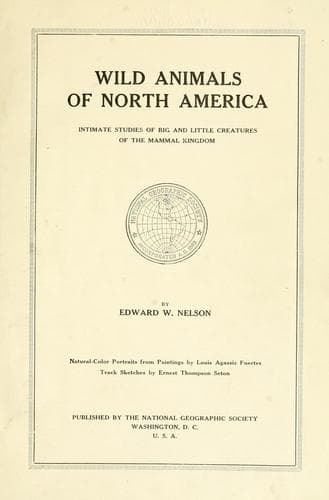
Wild Animals of North America: Intimate Studies of Big and Little Creatures of the Mammal KingdomNelson, Edward William
Science
Wild Animals of North America: Intimate Studies of Big and Little Creatures of the Mammal Kingdom
Nelson, Edward William
Mammals -- North America
Many interesting small mammals are nocturnal or lead such obscure and
hidden lives that they are rarely observed except by naturalists. Of
these are the numerous species of shrews, which include the smallest
mammals in the world. These tiny beasts all live among the vegetation
and debris on the surface of the ground or in little burrows below.
With the moles they are members of the order Insectivora and depend
mainly on insects and meat for food. Despite their minute size, they
are possessed of an indomitable courage and ferocity, which leads them
without hesitation to attack and kill mice many times their own weight.
The genus _Sorex_, of which the common shrew is a member, is
circumpolar in distribution, the various species ranging through
England, the European mainland, Asia, and North America as far south as
Guatemala.
The common shrew is a purely North American animal, occupying all
the northern part of the continent from the Arctic shores of Alaska
and Canada south to northern Nevada, South Dakota, Illinois, and
Pennsylvania, and along the Allegheny and high Rocky Mountains to North
Carolina and New Mexico. Its vertical range extends from the seacoast
up to timberline in the Rocky Mountains.
The common shrew is the smallest of the mammals in all the northern
parts of this continent, and one marvels at the possibility of such a
tiny morsel of flesh and blood withstanding the rigors of the arctic
winters. It measures about four inches in total length and weighs about
forty-five grains; the body and tail are slender, the nose long and
sharp, and the rim of the ears shows a little above the dense velvety
fur. By these characters it may be distinguished from the larger, more
heavily proportioned (and darker-colored) short-tailed shrews which
abound with it in certain parts of its range. Its smaller size and
grayish brown color are the main superficial differences between it and
other American members of the same genus. The climatic differences in
its wide range have developed several geographic races, none of which,
however, show strongly marked characters.
This shrew appears to have a most catholic taste, so far as its
surroundings are concerned, for it appears to frequent every type of
situation where shelter and food can be found. It abounds among the
peat beds and sphagnum mosses of the desolate barrens bordering on
the Arctic coast, as well as amid the rotten stumps, old logs, fallen
leaves, and other vegetable debris on the floor of the forests farther
south. It will be found also in the rank matted vegetation about
marshes, in old fields and occasional sphagnum swamps in the southern
parts of its range.
Public-domain text, read in full here on John Shaqi.
Reviews
Reviews
No reviews yet
Be the first to share your thoughts on this work.
Elsewhere in the archive
Join the Discussion
Join the discussion
Sign in to leave a comment or review.
Sign InorCreate an account