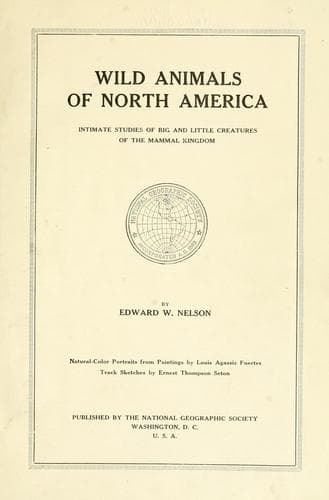
Wild Animals of North America: Intimate Studies of Big and Little Creatures of the Mammal KingdomNelson, Edward William
Science
Wild Animals of North America: Intimate Studies of Big and Little Creatures of the Mammal Kingdom
Nelson, Edward William
Mammals -- North America
Probably no mammal is more numerous in the eastern United States than
the short-tailed shrew. It occurs everywhere--in forests, in brushy
areas, in old fields, and along grassy banks. Within the city of
Washington it is common in Rock Creek Park, where it lives in covered
runs which it makes among the grass and fallen leaves. These shrews
drink frequently, and this may in part account for their abundance near
streams or other water, although it may be the desirable moist soil
conditions which draw them to such situations.
[Illustration: THE TRACK OF A COMMON COW (A SMALL ONE)
It is well to take the tracks of domestic animals as standards in
identifying tracks of wild big game. The roundness of the front foot
and the narrowness of the hind are general characteristics, though not
always so pronounced as here. But note that the hind foot is set ahead,
beside, or behind the trail of the front foot, but rarely exactly on
it. This peculiarity is commonly seen in animals that are accustomed to
walk on bogs. Note also the toes are set pointing a little outward, not
straight forward. The clouts, or accessory hoofs, rarely show; only in
deep, soft ground.]
The runways of these shrews are scarcely half an inch wide, usually
partly sunken in the mold or rotting surface vegetation. These are not
made by digging, but by pushing aside the loose mold, and they cross
and re-cross in an irregular network. They lead to the entrances to
burrows which generally drop nearly straight down. The burrows are
sometimes amid the leaves, but usually under the shelter of a root,
stump, old log, or other cover. In addition to their own runways, the
shrews make free use of the runs of meadow mice and even traverse the
tunnels of the pine mice and moles in their restless search for prey.
Small rounded chambers opening off their underground runways are filled
with fine grass, pieces of leaves, and other soft matter for a nest.
One nest examined was made entirely from the hair of meadow mice,
probably the spoils of war from the bodies of victims. As a rule,
shrews are extremely unsocial, but a pair of this species is sometimes
found occupying the same nest, no doubt a temporary arrangement.
Several litters, containing from four to six each, appear to be born
through the summer and fall, usually beginning in June.
Public-domain text, read in full here on John Shaqi.
Reviews
Reviews
No reviews yet
Be the first to share your thoughts on this work.
Elsewhere in the archive
Join the Discussion
Join the discussion
Sign in to leave a comment or review.
Sign InorCreate an account