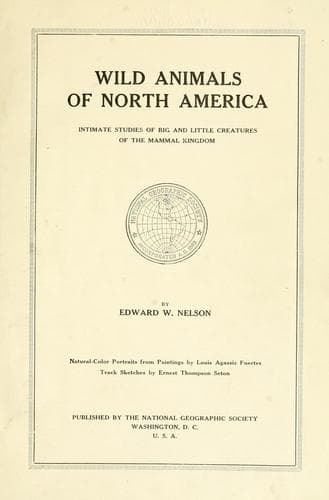
Wild Animals of North America: Intimate Studies of Big and Little Creatures of the Mammal KingdomNelson, Edward William
Science
Wild Animals of North America: Intimate Studies of Big and Little Creatures of the Mammal Kingdom
Nelson, Edward William
Mammals -- North America
While equally active by day and by night, the eyes of these shrews seem
to be of little use except to distinguish between light and dark, but
their senses of hearing and smell are highly developed, as is also the
sense of touch in their long hairs, or “whiskers,” about the nose.
In captivity an extreme sensitiveness is exhibited to sudden sounds,
especially such as those of a bird’s wings, indicating an instinctive
fear born of age-long persecution by birds of prey. Food is located
by smell, and as the flexible end of the snout is moved continually
from side to side, odors are caught which may register conceptions as
definite in the minds of these small animals as sight does in more
favored beasts. All shrews are provided with musk glands and on account
of these are apparently nauseous to most other animals, as they are
rarely eaten by beasts of prey. These musky secretions must be of great
service to facilitate them in locating one another.
[Illustration: THE SHORT-TAILED SHREW, OR BLARINA
The curious grooved track in the snow with the tail mark is seen on the
left (see pages 566 and 593).]
Like other shrews and the moles, their digestion appears to be very
rapid and they will eat two or three times their own weight in a
day. This necessitates great activity on their part during much of
the time in order to find the required food. They prefer insects and
meat, but are practically omnivorous, feeding not only upon many kinds
of insects, but on earthworms, slow-worms, sow-bugs, snails, slugs,
mice, shrews, and the young of ground-nesting birds, as well as such
vegetable food as beechnuts, seeds, bread, and oatmeal.
The instinct of prevision against the season of winter scarcity appears
to be developed in them, as one in captivity buried beechnuts in the
earth, and they are known to store living snails in small piles and to
gather disabled beetles in store-rooms in their tunnels.
The courage and blind ferocity of the short-tailed shrews when they
are placed near captive mice far larger than themselves, is amazing
to all who witness their encounters. They attack instantly, spreading
their front feet to gain a firmer footing and moving forward in
little rushes. Mice larger and much more powerful than the shrew are
persistently attacked and, finally giving out, are pounced upon and the
flesh torn from their heads and necks with ravening eagerness. One day
a passing observer heard a loud squealing on a railroad bank where an
examination revealed a short-tailed shrew dragging away a nearly dead
pine mouse, though the mouse was much the heavier. The notes of shrews
are a fine tremulous squeak which becomes a longer, harsher, and more
twittering or chattering cry when they are angry.
[Illustration: DOG GALLOPING IN SNOW
Showing the curious change whereby the right front ceases to take first
place; no doubt this rests the muscles a little. This is typical of
many animals (see page 597).]
Public-domain text, read in full here on John Shaqi.
Reviews
Reviews
No reviews yet
Be the first to share your thoughts on this work.
Elsewhere in the archive
Join the Discussion
Join the discussion
Sign in to leave a comment or review.
Sign InorCreate an account