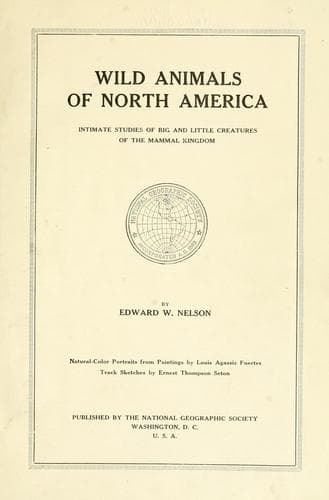
Wild Animals of North America: Intimate Studies of Big and Little Creatures of the Mammal KingdomNelson, Edward William
Science
Wild Animals of North America: Intimate Studies of Big and Little Creatures of the Mammal Kingdom
Nelson, Edward William
Mammals -- North America
One of the most unusual characteristics of the red bat is found in the
number of young it bears. Usually other species, except the hoary bat,
have one or two young, but at varying dates between May and July each
year the red bat produces from two to four, the average being three or
four. The young when very small are carried clinging to the body of
the mother in her flights. She continues to take them from place to
place in this manner until their combined weight exceeds her own. The
strength of the maternal feeling in this species is well illustrated by
an instance in Philadelphia where a boy caught a half-grown red bat in
a city square and carried it home. In the evening, three hours later,
he crossed the same square, carrying the young bat in his hand, when
the old one came circling about him and finally in her deep anxiety
alighted on his breast. Both were brought in, the young one clinging to
its mother’s teat. The devoted mother received injuries when she was
captured, from which she died two days later.
In the contact between mankind and bats, man, the invariable aggressor,
finds the bats baring their teeth, biting viciously, squeaking, and
behaving altogether like little fiends. A gentler side is sometimes
exhibited, however, and one observer who caught a partly grown red
bat found that it became tame, showed intelligence, and developed a
friendly feeling for its captor.
THE HOARY BAT (Nycteris cinereus)
The hoary bat is a close relative of the red bat described above, but
is larger, about five inches long, and, as its name implies, is of a
different color. It is widely distributed over a large part of North
America, where it is known to breed from Nova Scotia, Manitoba, and
the southern shore of Great Slave Lake south practically throughout
the United States. It is one of our larger species and is remarkable
for its power and skill on the wing. The wings are long and narrow and
carry their owner through the air in a bewildering series of swoops,
curves, and zigzag turns remarkable even in a group of animals so
notable for their powers of flight.
With the approach of cold weather the hoary bat migrates from the
northern parts of its range to the milder southern districts. It is a
late migrant, not leaving its northern home until the last of September
or October and returning in May. Some individuals appear to remain in
the North all winter, as one has been taken in Connecticut in December.
In its southern flight it wanders as far as Jalisco, near the southern
end of the Mexican table-land, to Lower California, and to the Bermuda
Islands. To reach the Bermudas it is evident the bat must make a
continuous flight from the nearest point on our shores of at least 580
miles--a good tribute to its wing power.
Public-domain text, read in full here on John Shaqi.
Reviews
Reviews
No reviews yet
Be the first to share your thoughts on this work.
Elsewhere in the archive
Join the Discussion
Join the discussion
Sign in to leave a comment or review.
Sign InorCreate an account