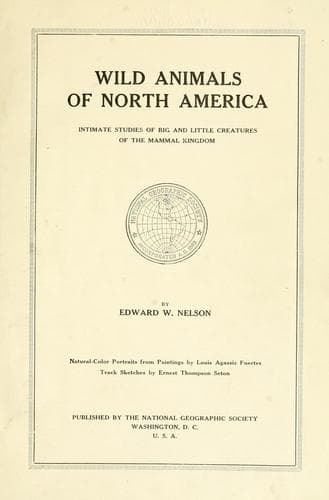
Wild Animals of North America: Intimate Studies of Big and Little Creatures of the Mammal KingdomNelson, Edward William
Science
Wild Animals of North America: Intimate Studies of Big and Little Creatures of the Mammal Kingdom
Nelson, Edward William
Mammals -- North America
The red bat rarely or never seeks shelter in gloomy caves and crevices,
but hangs to the small twigs or leaf stems on trees and bushes in the
full light of the sun. One observer in Texas on July 4 found four of
them hanging in a cluster from a twig on a peach tree, with the sun
shining full on them, although the temperature in the shade was 82
degrees Fahrenheit. I have found them in northern Illinois in the
glaring sunlight of May, hanging from leaves in the tops of oak trees.
This unusual tolerance of light in a member of the bat tribe is further
shown by its habit of beginning to hunt through the air for insects
earlier in the afternoon than other species in its range.
[Illustration: BIG DOG TROTTING
This track of a big dog trotting in about two and a half inches of snow
is singular in the perfect register it shows. The hind foot drops each
time into the track of the front foot. This correct style is more usual
with wild than with tame animals. Compare with track of dog galloping,
page 596.]
[Illustration: A COMMON DOG
The hind feet are, as usual, narrower, though nearly as long as the
front. The dog is a loose walker. Sometimes the hind foot is on the
track of the front, sometimes ahead, and often behind. The claws show.
The dragging of the front feet is another slovenly habit, an evidence
of overdomestication.]
Long, narrow wings and swift, powerful flight characterize the red bats
in the air. They have marvelous control in darting and turning here and
there, and no birds, except possibly the chimney swifts, can equal them
in their extraordinary gyrations.
Red bats are known to migrate from the northern part of their range
in September or October and to return in May. They have been seen
going south at Cape Cod the last of August and in September; and late
in October Dr. E. A. Mearns has recorded great flights of them down
the Hudson Valley, lasting throughout the day. That they share the
vicissitudes of migrating birds is indicated by observation on the New
Jersey coast of stray individuals coming in from the sea exhausted
early on September mornings.
They are among the most solitary of their kind, usually being found
hanging singly on a tree or bush, sometimes within a few feet of the
ground. On occasion they gather in clusters as mentioned above, and in
one instance in Maryland more than a dozen were hanging in a compact
ball, which suddenly exploded into its winged parts when disturbed.
Public-domain text, read in full here on John Shaqi.
Reviews
Reviews
No reviews yet
Be the first to share your thoughts on this work.
Elsewhere in the archive
Join the Discussion
Join the discussion
Sign in to leave a comment or review.
Sign InorCreate an account