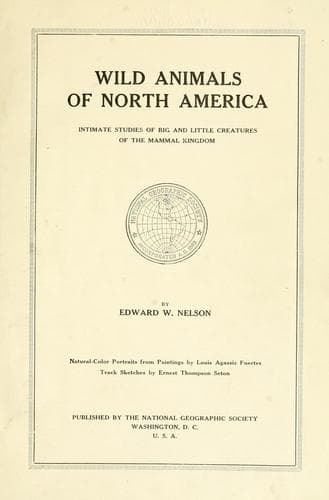
Wild Animals of North America: Intimate Studies of Big and Little Creatures of the Mammal KingdomNelson, Edward William
Science
Wild Animals of North America: Intimate Studies of Big and Little Creatures of the Mammal Kingdom
Nelson, Edward William
Mammals -- North America
Reference has been made in several preceding sketches of this series to
the mammals of tropical origin which have invaded our southern border.
The Mexican bat is a notable member of this class. It differs in many
curious ways from the bats with which it associates in temperate
regions. It is smaller than any of the other three bats treated here
and is strongly characterized by a flattening of the head and body
which enables it to creep into a surprisingly narrow crevice in the
rocks or elsewhere. The ears are broad and flaring and extend forward
over the eyes like the visor of a cap, and the end of the tail is not
confined within the membrane extending between the hind legs, but
projects from it. Another pronounced characteristic of this bat and
one highly disagreeable is the rank musky odor which it gives out.
This pollutes the air about its harboring places, rendering it a most
unwelcome guest.
Whoever has visited the Southern and Southwestern States or Mexico must
have noted the offensive odor in many places about the verandas of
houses and especially about old churches and other public buildings.
This is the sign of occupancy placed on the premises by the Mexican
bats, which, to the number of a few dozens or actually by thousands, as
conditions permit, may lie snugly hidden in cracks and dark openings
of all kinds about the roof and walls. No other bat in Mexico or the
United States is provided with so strong an odor.
[Illustration: MUSK-OX
Drawn from the tracks of a big bull in the barren grounds of Canada.
Much like the track of a common cow (see page 594), but more rounded
and less deeply cloven; also, I think, less often sprawling--in other
words, more often hind foot on front track; for the musk-ox is more of
an upland creature.]
The Mexican bat is extremely abundant, probably exceeding in numbers
any other species within its territory. It ranges throughout the
tropical and lower temperate parts of Guatemala, Mexico, and across our
border, throughout most of Texas, and east as far as Florida and South
Carolina; in the West it also abounds both in town and country in the
warmer parts of New Mexico, Arizona, and California.
Closely allied relatives of the Mexican bat abound throughout the
warmer parts of Central and South America to beyond Brazil. The genus
to which this species belongs is represented in the warmer parts of
both hemispheres. It extends north in the Old World to southern Europe
and also is found in the Philippines.
Public-domain text, read in full here on John Shaqi.
Reviews
Reviews
No reviews yet
Be the first to share your thoughts on this work.
Elsewhere in the archive
Join the Discussion
Join the discussion
Sign in to leave a comment or review.
Sign InorCreate an account