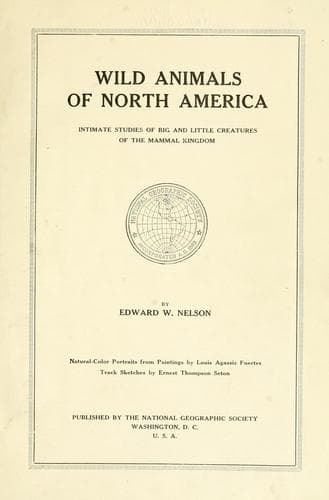
Wild Animals of North America: Intimate Studies of Big and Little Creatures of the Mammal KingdomNelson, Edward William
Science
Wild Animals of North America: Intimate Studies of Big and Little Creatures of the Mammal Kingdom
Nelson, Edward William
Mammals -- North America
The abundance of the Mexican bat in some favorable places is almost
incredible. At Tucson, Arizona, I once saw them, a short time before
dark, issuing from a small window in the gable of a church in such
numbers that in the half light they gave the appearance of smoke
pouring out of the opening. At times they occupy houses in such numbers
that their presence and accompanying offensive odor render the places
uninhabitable. At the town of Patzcuaro, near the southern end of the
Mexican table-land, I saw two rooms in an old adobe house occupied by
as many of them as could possibly hang from the rough ceiling. The
owner considered their presence a valuable asset, as he collected and
sold the guano for more than the rooms would have brought in rent. The
bats congregate in even greater numbers in large caves. So numerous are
they in certain caves in Texas that the owner reports an annual income
of about $7,000 from the guano.
They are very plentiful by day in the thin crevices about the roof and
walls of caves in the celebrated Ixtapalapa, or “Hill of the Star,”
beyond the floating gardens at the City of Mexico, and I also found
them living in many of the marvelous ruins of Mexico, including
Chichen-Itza, in Yucatan. Wherever they occur in numbers they may be
heard frequently by day shuffling uneasily about and squeaking shrilly
at one another.
[Illustration: BADGER
The huge fore claws are a strong feature. The hind claws rarely show
in the track. The broad spread of the tracks in the lower trail
corresponds with the low, thick form of the animal.]
When they first come out after sunset they usually fly away in a great
stream, nearly all in the same direction, as though migrating. This
course will probably be found leading to water, where they scoop up
a drink from the surface before beginning their wonderfully erratic
zigzags through the air in pursuit of insects.
From the colder northern parts of their range they migrate southward to
milder climatic conditions or descend to lower altitudes. In Mexico,
where they live up to above 8,000 feet altitude, they move down from
one to two thousand feet. Their young, one at a birth, are born from
April to May.
It has been claimed that the Mexican bat brings bedbugs to infest
houses. This is untrue of this or any other bat. These animals have
certain small parasites, some of which, resembling small bedbugs, have
probably given rise to the belief mentioned. These parasites live only
on the bats.
[Illustration: THE TRACK OF A BIG BULL MOOSE WALKING ON HARD GROUND
Public-domain text, read in full here on John Shaqi.
Reviews
Reviews
No reviews yet
Be the first to share your thoughts on this work.
Elsewhere in the archive
Join the Discussion
Join the discussion
Sign in to leave a comment or review.
Sign InorCreate an account