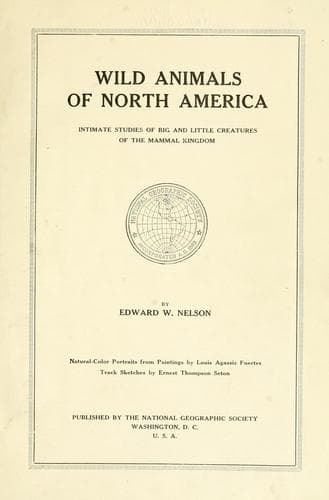
Wild Animals of North America: Intimate Studies of Big and Little Creatures of the Mammal KingdomNelson, Edward William
Science
Wild Animals of North America: Intimate Studies of Big and Little Creatures of the Mammal Kingdom
Nelson, Edward William
Mammals -- North America
The marvelous variations in structure of the ears and other organs
about the heads of insect-eating bats serve probably as microphones
by which the flight of their prey may be detected and its direction
located with instantaneous certainty. The beautiful accuracy with
which this hearing mechanism works must be evident to any one who will
take a position where he may have the evening glow of the western sky
as a background for flights of bats. It is certain that the small
and ineffective eyes these animals possess could never locate their
minute flying game and enable them to secure it in the whirling, zigzag
courses they pursue, often at a speed and under a control which few, if
any, birds could rival.
The great ears of the big-eared desert bats illustrate one form
of a highly developed hearing apparatus and give these animals a
handsome and strikingly picturesque appearance. This character at once
distinguishes them from others of their kind in the United States.
The distribution of this species lies mainly in the arid parts of
the Southwestern States and Mexico. It extends from western Texas,
southern Colorado, Nevada, and Oregon, south to Queretaro, on the
Mexican table-land, and to the southern end of the peninsula of Lower
California. The vertical distribution extends from sea-level up to at
least 5,000 feet altitude.
By day these desert bats live in crevices and caves in cliffs, in old
mining tunnels, hollows in trees, and in sheltered places about the
roofs and walls of houses, barns, or other buildings. Their presence
in dark hiding places may sometimes be detected by occasional grating
squeaks. They appear to lack any musky odor which characterizes so
many bats. About the 1st of June each year either one or two young are
born, and for a time these cling to the mother’s breast and are carried
during her swift flights in pursuit of insect prey.
Often when camping at desert waterholes, I have seen them come in just
before dark to drink, scooping up water from the surface while in
flight, and then circling back and forth over the damp ground at an
elevation of a few yards for the capture of some of the insects common
in such places. At such times, with the distant hills mantled with a
deepening purple haze and the pulsating heat of the day replaced by
the milder temperature of approaching night, these bats could often be
seen sharply outlined against the rich orange afterglow of the departed
sun. Here and there in the still air flickered and zigzagged multitudes
of tiny bats, like black butterflies, and among them the occasional
big-eared bats on broad wings appeared huge in contrast. Their wing
strokes were slower and shorter than those of the smaller species and
impelled them forward in a swift, gliding movement which gave their
evolutions a sweeping grace beautiful to see.
Public-domain text, read in full here on John Shaqi.
Reviews
Reviews
No reviews yet
Be the first to share your thoughts on this work.
Elsewhere in the archive
Join the Discussion
Join the discussion
Sign in to leave a comment or review.
Sign InorCreate an account