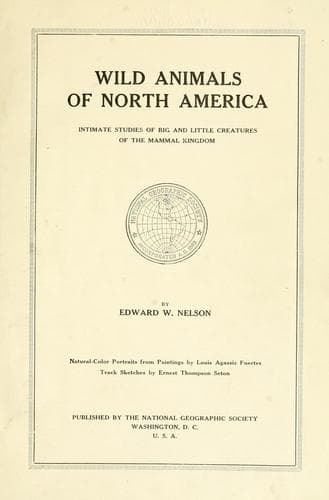
Wild Animals of North America: Intimate Studies of Big and Little Creatures of the Mammal KingdomNelson, Edward William
Science
Wild Animals of North America: Intimate Studies of Big and Little Creatures of the Mammal Kingdom
Nelson, Edward William
Mammals -- North America
In August several years ago, during a visit to the Indian School at
Tuba, in the Painted Desert of northern Arizona, I found these bats
living in considerable numbers about the buildings. Just before dark
they swarmed out and hunted about the surrounding orchards and small
fields. One evening my collector shot at one as it circled over a
potato field in a small orchard. It continued its flight, circling low
among the apple trees as though unhurt, when suddenly it dropped to the
ground. Supposing the bat to be wounded, it was cautiously approached
and covered with a hat, when, without a struggle, it permitted itself
to be picked up by the nape. It then became evident that the bat was
unhurt from the shot. The reason for its sudden descent was revealed in
the person of a large, fat mole cricket (_Stenopalmatus fuscus_) which
it was holding firmly in its jaws, and so ferociously intent was it in
biting and worrying its luscious prey that it paid not the slightest
attention to its captor. Finally it was killed by having its chest
compressed and died with its bull-dog grip on its prey unbroken.
These bats, like the other members of the tribe in the United States,
are fully as beneficial to the farmer as the best of our insect-eating
birds and deserve equal protection in place of the general persecution
from which they now suffer.
[Illustration: ROCKY MOUNTAIN GOAT
Kinship with sheep and antelope is reflected in the track of the goat.
Its heel-pads are so large and rubber-like that the track is rarely
so sharp as here shown. “Although marvelously surefooted and fearless
in traversing the faces of high precipitous slopes, goats lack the
springy grace and vivacity of mountain sheep and move with comparative
deliberation.”]
[Illustration: BIGHORN
The general style of a bighorn track is like that of deer, but the
toes are finished off more squarely and the hollow in the outer edge
of each hoof is a strong characteristic. Sometimes the tracks are in
correct register. The clouts rarely show. The dung pellets are like
those of the deer, but rounder. The track is that of a ewe; the ram’s
is similar, but larger.]
[Illustration: MOUNTAIN LION, OR COUGAR
The track of a mountain lion is much like that of a house cat,
differing only in size. Sometimes, as in the cat, the hind foot is set
exactly on the track of the front foot.]
[Illustration: GRAY WOLF
The track is that of a large wolf. There is no certain way of
distinguishing it from that of a dog (see page 597). Size and
probabilities must be considered.]
[Illustration: WHITE-TAILED DEER WALKING
The track of the white-tail is ideal--a starting point to study all the
tracks. Sometimes the hind foot fits on the front track, but sometimes
not.]
[Illustration: WHITE-TAILED DEER BOUNDING
In these the clouts are clearly shown. Note the resemblance to the
tracks of the moose (see page 602), which differ chiefly in their
greater size.]
[Illustration: WHITE-TAILED DOE WALKING
Public-domain text, read in full here on John Shaqi.
Reviews
Reviews
No reviews yet
Be the first to share your thoughts on this work.
Elsewhere in the archive
Join the Discussion
Join the discussion
Sign in to leave a comment or review.
Sign InorCreate an account