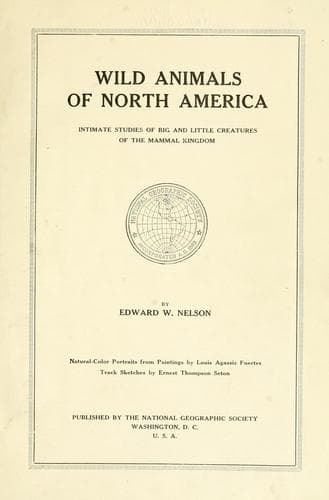
Wild Animals of North America: Intimate Studies of Big and Little Creatures of the Mammal KingdomNelson, Edward William
Science
Wild Animals of North America: Intimate Studies of Big and Little Creatures of the Mammal Kingdom
Nelson, Edward William
Mammals -- North America
This track differs from that of the buck in being smaller, slimmer, and
in having the toes pointing forward or inward--rarely outward.]
[Illustration: ELK
This shows the track of a large male walking. Each hoof-mark is about
4½ inches long. Had it been five inches it would have meant a very
large bull. The track is strictly deer-like in type, but has a little
of the roundness of point that is so marked in the domestic cow. At the
upper end of the drawing is snow one inch deep. Here no clouts show; at
the lower end it is three inches deep, so the clout-marks are clear.
Size is essential in distinguishing the track. The dung pellets, about
⅝ × ⅛ inch, are also important.]
[Illustration: MULE DEER
The mule deer tread cannot be distinguished with certainty from that
of white-tailed or coast deer; yet it averages larger than either
of these, and the curious close set together of all four feet while
it does its peculiar bounding is quite unlike what we see in the
white-tail track. “These deer are not good runners in the open. On
level country in Arizona I have ridden after and readily overtaken
parties of them within a mile. The moment rough country was reached,
however, with amazing celerity a series of mighty leaps carries them
away” (see page 456).]
[Illustration: GRIZZLY BEAR
The great size and the immense claws are the chief characteristics of
the grizzly’s track. All five toes usually show in each track. “The
strongest and most distinctive characteristic of the grizzlies is the
long, proportionately slender and slightly curved claws of the front
feet, sometimes more than three inches long” (see pages 440 and 442).]
[Illustration: BLACK BEAR
The plantigrade foot is clearly shown in the bear track. That of a
black bear differs from that of a grizzly, first in size, second in the
shortness of the claws. Usually no claws show, and the fifth toe, which
is well developed on both front and hind paws, leaves little sign and
often none at all. Frequently the hind foot is set on the track of the
front foot in correct register.]
[Illustration: THE HUMAN FOOTPRINTS
The footprints of the human animal are included in this series of
sketches for the purpose of comparison. Especially interesting is the
similarity to be noted between the tracks made by man and those of
the grizzly and the black bear (see page 608). The tracks shown on
the left half of this page present the moccasin-shod footprints of a
Sioux Indian compared with the shoe tracks of a white man. On the right
are shown: (A) a woman’s foot which has been much pinched by tight
shoes; (B) a sturdy boy’s foot, somewhat too flat to be normal; (C)
the footprint of a slender man, and (D) the imprint of a robust man’s
foot.]
[Illustration: THE HORSE
Public-domain text, read in full here on John Shaqi.
Reviews
Reviews
No reviews yet
Be the first to share your thoughts on this work.
Elsewhere in the archive
Join the Discussion
Join the discussion
Sign in to leave a comment or review.
Sign InorCreate an account