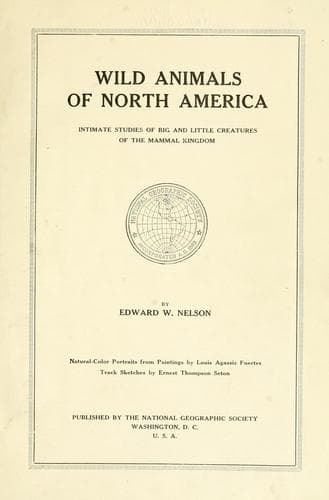
Wild Animals of North America: Intimate Studies of Big and Little Creatures of the Mammal KingdomNelson, Edward William
Science
Wild Animals of North America: Intimate Studies of Big and Little Creatures of the Mammal Kingdom
Nelson, Edward William
Mammals -- North America
Its reptile-eating habit was revealed to me unexpectedly one day in
the dense tropical forest of Chiapas. I was riding along a steep trail
beside a shallow brush-grown ravine when a tiger-cat suddenly rushed up
the trunk of a tree close by. A lucky shot from my revolver brought
it to the ground, and I found it lying in the ravine by the body of a
recently killed boa about 6 or 7 feet long. It had eaten the boa’s head
and neck when my approach interrupted the feast.
The first of these cats I trapped in Mexico was captured the night
after my arrival, in a trail bordering the port of Manzanillo, on the
Pacific coast. The rejoicing of the natives living close by evidenced
the toll this marauder had been taking from their chickens.
The tiger-cat is much more quiet and less fierce in disposition than
most felines. It excited my surprise and interest whenever I trapped
one to note how nonchalantly it took the situation. The captive never
dashed wildly about to escape, but when I drew near sat and looked
quietly at me without the slightest sign of alarm and with little
apparent interest. A small trap-hold, even on the end of a single toe,
was enough to retain the victim. On one occasion, while a cat thus held
sat looking at me, it quietly reached to one side and sank its teeth
into the bark of a small tree to which the trap was attached, and then
resumed its air of unconcern.
The tiger-cat brings within our fauna an interesting touch of the
tropics and its exuberance of animal life. It is found in so small a
corner of our territory, however, that, despite its mainly inoffensive
habits, it is certain to be crowded out in the near future by the
increased occupation of its haunts.
=RED FOX= (=Vulpes fulva= and its relatives)
Red foxes are characterized by their rusty red fur, black-fronted fore
legs, and white-tipped tail. They inhabit the forested regions in the
temperate and subarctic parts of both Old and New Worlds, and, like
other types of animal life having a wide range, they break up into
numerous distinct species and geographic races.
In America they originally ranged over nearly all the forested region
from the northern limit of trees in Alaska and Canada south, east of
the Great Plains, to Texas; also down the Rocky Mountains to middle
New Mexico, and down the Sierra Nevada to the Mount Whitney region
of California. They are unknown on the treeless plains of the West,
including the Great Basin. Originally they were apparently absent from
the Atlantic and Gulf States from Maryland to Louisiana, but have since
been introduced and become common south to middle Georgia and Alabama.
Public-domain text, read in full here on John Shaqi.
Reviews
Reviews
No reviews yet
Be the first to share your thoughts on this work.
Join the Discussion
Join the discussion
Sign in to leave a comment or review.
Sign InorCreate an account