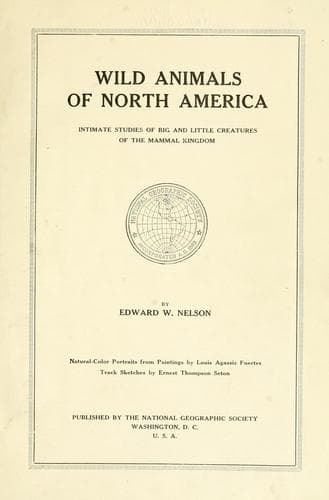
Wild Animals of North America: Intimate Studies of Big and Little Creatures of the Mammal KingdomNelson, Edward William
Science
Wild Animals of North America: Intimate Studies of Big and Little Creatures of the Mammal Kingdom
Nelson, Edward William
Mammals -- North America
In order to fit properly into a high northern environment, Arctic
wolves have developed white coats, which they wear throughout the year.
They are among the largest of their kind and have all the surpassing
vigor needful for successful beasts of prey in the rigors of such a
home. Nature is more than ordinarily hard on weaklings in the far North
and only the fittest survive.
The range of the white wolves covers the treeless barren grounds
bordering the Arctic coast of Alaska and Canada and extending thence
across the Arctic islands to the north coast of Greenland beyond 83
degrees of latitude.
The short summer in the far North is the season of plenty, during which
swarms of wild-fowl furnish a bountiful addition to the regular food
supply. Young wolves are reared and the pack feeds fat, laying up a
needed reserve strength for the coming season of darkness. When winter
arrives lemmings and Arctic hares and an occasional white fox furnish
an uncertain food supply for such insistent hunger as that of wolves,
and larger game is a necessity.
In the northern part of their range they share with the other denizens
of that land the months of continuous night. There, amid relentless
storms and iron frosts, the trail, once found, must be held to the
end. The chase is made in the gloom of continuous night and the white
caribou or musk-ox herd is brought to bay, and by the law of the pack
food is provided.
White wolves are the one dreaded foe Nature has given the musk-ox and
the caribou in the northern wilds. The number of the wolves, as with
other carnivores, varies with the abundance of their chief prey, and
they will disappear automatically with the caribou and musk-oxen.
=GRAY, OR TIMBER, WOLF= (=Canis nubilus= and its relatives)
Large wolves, closely related to those of Europe and Siberia, once
infested practically all of Arctic and temperate North America,
excepting only the arid desert plains. This range extended from the
remotest northern lands beyond 83 degrees of latitude south to the
mountains about the Valley of Mexico.
When America was first colonized by white men, wolves were numerous
everywhere in proportion to the great abundance of game animals. With
the increased occupation of the continent and the destruction of most
of its large game, wolves have entirely disappeared from large parts of
their former domain. They still occur in varying numbers in the forest
along our northern border from Michigan westward, and south along the
Rocky Mountains and the Sierra Madre to Durango, Mexico, and also in
all the Gulf States.
The variations in climate and other physical conditions within their
range has resulted in the development of numerous geographic races,
and perhaps of species, of wolves, which show marked differences in
size and color. The white Arctic wolf, described on pages 421 and 424,
is one of the most notable of these, but the gray wolf of the Rocky
Mountain region and the eastern United States is the best known.
Public-domain text, read in full here on John Shaqi.
Reviews
Reviews
No reviews yet
Be the first to share your thoughts on this work.
Join the Discussion
Join the discussion
Sign in to leave a comment or review.
Sign InorCreate an account