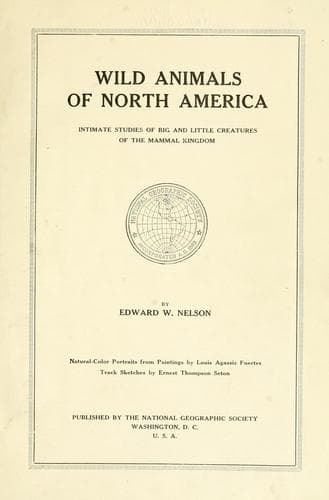
Wild Animals of North America: Intimate Studies of Big and Little Creatures of the Mammal KingdomNelson, Edward William
Science
Wild Animals of North America: Intimate Studies of Big and Little Creatures of the Mammal Kingdom
Nelson, Edward William
Mammals -- North America
The old males attain a length of 22 feet or more and are huge, ungainly
beasts, moving with difficulty on land, but with ease and grace in
the water. The name sea-elephant is obviously derived from the broad
flexible snout of the males, which, when relaxed, hangs 6 or 8 inches
below the muzzle. This curious proboscis can be moved about and raised
vertically, giving the animal a strange appearance. The males have a
loud roar like the bellowing of an ox.
The breeding season extends from February to June, and during this
period these seals are far more numerous on shore than at any other
time. They are gregarious in habits and formerly hauled up in herds on
the islands or on remote and inaccessible beaches of the mainland. On
shore they are sluggish, having none of the alertness shown by many
other seals. They lie supine on the sand and permit a man to walk
quietly up and touch them without showing signs of fear. When attacked
by sealers or otherwise alarmed, however, they become panic-stricken
and make ungainly efforts to escape, but quickly become exhausted by
the exertion necessary to move their great bodies. Their only natural
enemy appears to be the killer whale.
Between 1855 and 1870 the great numbers of northern sea-elephants,
combined with their helplessness on shore and the value of their
oil, attracted numerous sealing and whaling ships to the coast of
Lower California. The resulting slaughter reduced these animals from
swarming abundance to a few scattered herds. Since then their numbers
have steadily decreased, and there is a serious probability that these
strange and interesting habitants of the sea will soon disappear
forever.
The small remaining herd on Guadalupe Island is without protection
and lies at the mercy of wanton hunters. The people of the coastal
towns of California should exert themselves to discourage hunters from
killing these seals, since the only hope for the preservation of this
noteworthy species lies in an awakened public sentiment in its favor.
Even within recent years they have occasionally visited the Santa
Barbara Islands, California, and if the existing survivors can be saved
they may again become resident there.
HARBOR SEAL, OR LEOPARD SEAL (Phoca vitulina)
The harbor seal, one of the smallest of the hair seals, attaining a
length of only 5 or 6 feet, is one of the most widely distributed and
best known of its kind. It is a circumpolar species, formerly ranging
well south on the European coast and to the Carolinas on the American
side of the Atlantic, though now more restricted in its southern
extension. On the North Pacific it ranges south to the coast of Japan
on the Asiatic side and to Lower California on the American side.
Public-domain text, read in full here on John Shaqi.
Reviews
Reviews
No reviews yet
Be the first to share your thoughts on this work.
Elsewhere in the archive
Join the Discussion
Join the discussion
Sign in to leave a comment or review.
Sign InorCreate an account