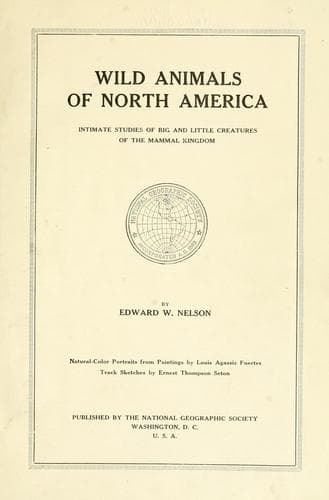
Wild Animals of North America: Intimate Studies of Big and Little Creatures of the Mammal KingdomNelson, Edward William
Science
Wild Animals of North America: Intimate Studies of Big and Little Creatures of the Mammal Kingdom
Nelson, Edward William
Mammals -- North America
Throughout its range the harbor seal haunts the coast-line, frequenting
rocky points, islets, bays, harbors, and the lower courses of rivers.
It commonly frequents the sandy bars exposed at low tide about the
mouths of rivers, and has been known to ascend the St. Lawrence to
Lake Champlain and Lake Ontario, and the Yukon to several hundred
miles above its mouth. It is still a common and well-known animal on
the coast of Maine and eastern Canada and about many harbors on the
Pacific coast. It appears to be a non-migratory species and in northern
waters frequents the pack ice along shore in winter. Where the pack
is unbroken, the seal makes breathing holes through the ice, which it
visits at intervals, and where it is hunted by the Eskimos.
It is not polygamous and is not so strongly gregarious as some of the
other seals. That it has some social instinct is evident, however,
since it commonly gathers in small herds on the same sand spits, rocky
points, and islets. The young are born in early spring and at first are
entirely covered with a woolly white coat. The mother is devoted to the
“pup” and shows the deepest anxiety if danger threatens.
The flesh and blubber of this seal are highly prized by the Eskimos
as the most palatable of all the seals, and the skin is valued for
clothing and for making strong rawhide lines used for nets and other
purposes. On the Alaskan coast of Bering Sea in fall the Eskimos
capture many seals in nets set off rocky points, just as gill nets are
set in the same places in spring for salmon.
Owing to the presence of this seal along so many inhabited coasts,
much has been written concerning its habits, especially as observed
about the shores of the British Isles. Where not disturbed it shows
little fear and will swim about boats or ships, raising its head high
out of water and gazing steadily with large intelligent eyes at the
object of its curiosity; but when hunted it becomes exceedingly shy and
wary. All who have held the harbor seal in captivity agree in praising
its intelligence. It becomes very docile, often learning a variety of
amusing tricks, and develops great affection for its keeper.
The small size of this seal and its limited numbers are elements which
save it from extensive commercial hunting and may preserve it far into
the future to add life and interest to many a rocky coast.
HARP SEAL, SADDLE-BACK, OR GREENLAND SEAL (Phoca grœnlandica)
The black head, gray body, and large dorsal ring of the male harp seal
are strongly distinctive markings in a group generally characterized
by plain dull colors. The harp seal is a large species, the old males
weighing from 600 to 800 pounds.
Public-domain text, read in full here on John Shaqi.
Reviews
Reviews
No reviews yet
Be the first to share your thoughts on this work.
Elsewhere in the archive
Join the Discussion
Join the discussion
Sign in to leave a comment or review.
Sign InorCreate an account