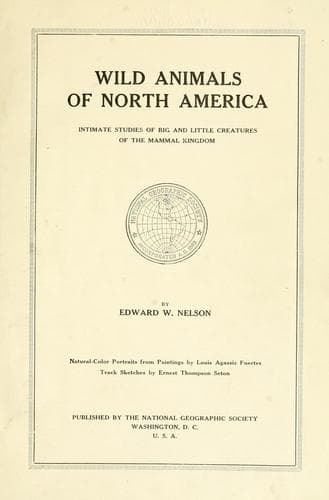
Wild Animals of North America: Intimate Studies of Big and Little Creatures of the Mammal KingdomNelson, Edward William
Science
Wild Animals of North America: Intimate Studies of Big and Little Creatures of the Mammal Kingdom
Nelson, Edward William
Mammals -- North America
Although never very abundant, otters are so shy and solitary in their
habits that they have managed to retain almost all of their original
range. They occur now and then in the Potomac, near Washington,
and in other rivers throughout the country, where their tracks may
occasionally be detected on sand-bars and in the muddy shallows along
the banks. A sight of the animals themselves is rare. Their dens are
usually in the banks of streams or lakes above or below the surface of
the water, under the roots of large trees, or beneath rocky ledges.
Otters are extremely playful and amuse themselves by sliding down steep
banks into the water, repeatedly using the same place until a smooth
chute or “slide” is defined. They usually have two to five young, which
remain with the mother until nearly grown.
While close relatives of the weasel, they are much more intelligent,
have a gentler disposition, and make playful and most interesting
pets. Their fur is highly prized and always brings a good price in the
market. As a result, they have been persistently hunted and trapped
since our pioneer days. That the species should continue to exist,
though in much diminished numbers, throughout most of its original
range is a striking evidence of its retiring habits and mental
acuteness.
[Illustration: FISHER, OR PEKAN]
[Illustration: OTTER]
[Illustration: ROCKY MOUNTAIN SHEEP]
[Illustration: COLLARED PECCARY, OR MUSKHOG]
COLLARED PECCARY, OR MUSKHOG (Pecari angulatus)
The numerous and extraordinarily varied species of wild pigs of the
Old World are represented in America by the peccaries, a specialized
group containing two species of small pigs peculiar to North and South
America. One of the many differences between them and their Old World
relatives is their having but two young. The name muskhog, applied to
them, is based on their possession of a large gland, located high up
on the middle of the rump, which emits a powerful odor. The musky odor
from this quickly permeates the flesh of a peccary unless it is cut out
as soon as the animal is killed.
The collared peccary is the smaller of the two species, usually
weighing less than 75 pounds. It ranges from the southwestern United
States south to Patagonia. Within this range numerous geographic races
have developed, varying from light grizzled gray to nearly black. It
formerly occurred within our border north to the Red River of Arkansas,
but is now limited to the southern half of Texas and the southern parts
of New Mexico and Arizona.
Public-domain text, read in full here on John Shaqi.
Reviews
Reviews
No reviews yet
Be the first to share your thoughts on this work.
Elsewhere in the archive
Join the Discussion
Join the discussion
Sign in to leave a comment or review.
Sign InorCreate an account